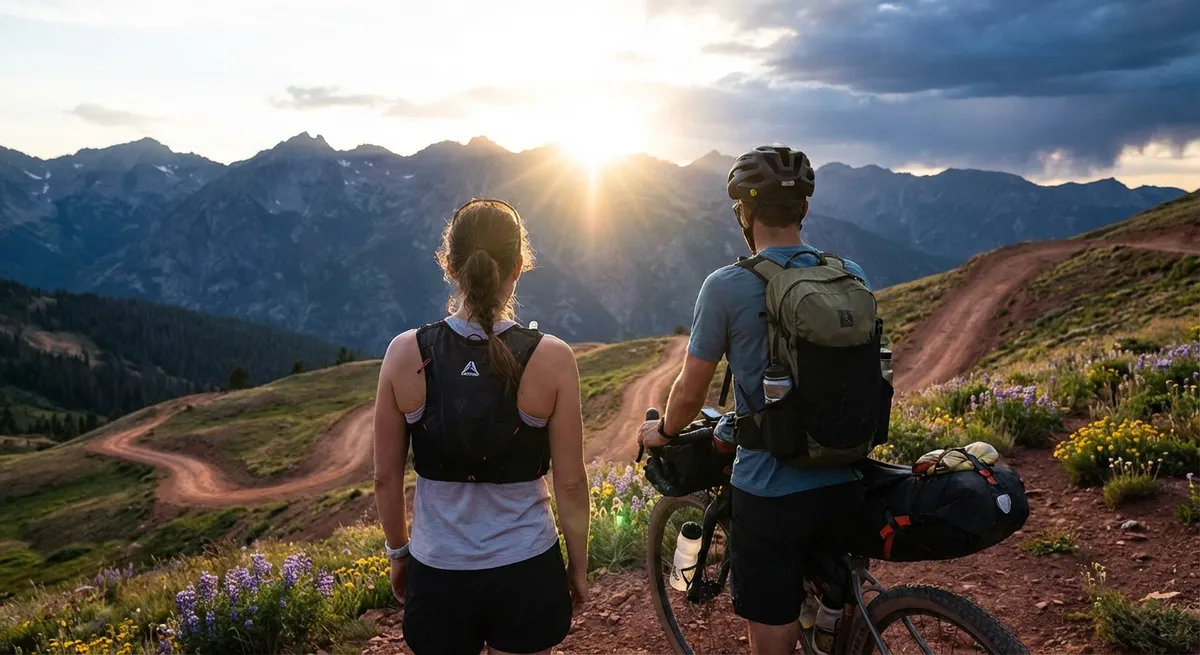
This guide dives into how to turn your next escape into a full-body, full-heart experience—with five actionable tips fitness adventurers will actually use, plus destination sparks to fire up your planning.
Why Active Travel Hits Differently
Active travel isn’t about ticking off landmarks; it’s about earning your view. You’re not just seeing a fjord, canyon, or rainforest—you’re climbing, paddling, pedaling, or trekking your way into it.
When you build movement into your journey, you:
- Anchor memories in your body: you’ll remember the steep switchbacks to that alpine lake every time your legs burn on a local hill.
- Connect deeper with local landscapes: different terrains challenge your balance, endurance, and grit in ways a treadmill never will.
- Sync with local life: you spot early-morning runners in Lisbon, cyclists in Copenhagen, surfers in Bali—and suddenly you’re not a visitor, you’re a participant.
- Return home fitter, not exhausted: done right, an active trip reboots your energy instead of draining it with late nights and airport stress.
Think of your passport stamps as mini milestones in your fitness journey. Each destination nudges a different part of your athletic potential awake.
Tip 1: Let the Landscape Choose Your Workout
Instead of forcing your usual routine onto a new place, flip the script: ask, “What does this landscape invite my body to do?” Then build your days around that.
- Coastal escapes –
- Sunrise beach runs in San Sebastián, Spain, where soft sand tests your stabilizers.
- Surf sessions in Costa Rica’s Pacific coast (Nosara, Santa Teresa) that torch your core and shoulders while you chase clean breaks.
- Coastal hiking in Cape Town’s Lion’s Head and Table Mountain, where every climb earns an ocean panorama.
- Mountain regions –
- Trail running or hut-to-hut trekking in the Italian Dolomites, combining elevation gain with rugged limestone drama.
- Downhill or enduro mountain biking in Whistler, Canada, where technical descents turn your legs into shock absorbers.
- High-altitude hikes in Peru’s Sacred Valley, gradually working up to bucket-list routes like Rainbow Mountain or Salkantay.
- Urban jungles –
- Stair-sprint “workouts” on the endless steps of Lisbon or Hong Kong.
- Long, tempo-style walks across New York City boroughs, from Brooklyn Bridge sunrise crossings to Central Park tempo loops.
- City bike commuting in Amsterdam or Copenhagen, where your quads work while you discover canals, cafes, and culture.
Let the terrain coach you. Flat? Go long and steady. Steep? Go short and powerful. Windy or wavy? Chase balance and core strength.
Tip 2: Train for the Trip Like It’s an Event
Treat your adventure like a race you actually want to remember. A bit of focused prep turns “I survived this hike” into “I owned that ridge line.”
4–6 weeks before departure:
- Mimic the terrain
- Headed for mountains? Add stair intervals, hill repeats, or incline treadmill hikes wearing a backpack.
- Planning urban walking marathons? Train with long walks or run-walk intervals for 60–90 minutes.
- Targeting cycling trips? Build back-to-back ride days to prepare for cumulative fatigue.
- Dial in your engine
- Two days a week of interval work (short, hard efforts with recovery) to sharpen power.
- One longer session a week at conversational pace to build endurance.
- Build “travel-proof” strength
- Squats or lunges (for climbs and stairs)
- Planks and side planks (for backpacks, paddling, and balance)
- Push-ups and rows (for carrying gear and posture)
Focus on functional movements you can maintain on the road:
Bonus: Practice with your actual travel shoes and daypack. Blisters and chafing are easier to manage in your hometown than halfway up a remote trail.
Tip 3: Pack Like an Athlete, Not a Tourist
Your pack should serve the adventure, not sabotage it. The right gear makes movement non-negotiable—and easier.
Non-negotiables for active travelers:
- Versatile footwear:
- One pair of light trail shoes that can handle city streets and rugged paths (think Girona’s cobblestones one day, Pyrenees trails the next).
- Quick-dry performance layers:
- Shirts and socks that dry overnight so you can wash-and-repeat—critical in humid spots like Bali or Thailand.
- Compact recovery tools:
- A mini massage ball or lacrosse ball and a resistance band can save your calves and hips in any hotel room or mountain hut.
- Hydration strategy:
- Collapsible water bottle or soft flask.
- Electrolyte tablets or powder, especially for hot climates like Morocco, Arizona, or Southeast Asia.
Smart tech choices:
- Offline maps (download regions on Google Maps or Maps.me) to avoid getting stranded mid-run or hike.
- Fitness watch or app to track vertical gain, distance, and effort—more for safety and pacing than for bragging rights.
Pack like everything you carry has to be earned with steps and sweat—because it does.
Tip 4: Build Movement into the Itinerary (Without Losing the Fun)
A powerful active trip doesn’t need to look like a boot camp. It just needs consistent, intentional movement threaded through your days.
Anchor your days with a “movement ritual”:
- Sunrise explorers:
- Lunch-hour movers:
- Sunset shifters:
20–40 minutes of easy running, brisk walking, or mobility before breakfast. Cities like Paris, Buenos Aires, or Tokyo feel entirely different before the crowds wake up.
Midday bike tour, kayak session, or local fitness class. Think SUP on Lake Bled in Slovenia or a midday bike-to-winery ride in Mendoza, Argentina.
Short stair sessions to a viewpoint (like Athens’ Lycabettus Hill), beach jogs, or yoga by the water.
Sample active day in Madeira, Portugal:
- Morning: Coastal jog or walk through Funchal’s promenade.
- Midday: Levadas hike through lush valleys and waterfalls.
- Evening: Gentle stretch on a roof terrace, refuel with grilled fish and local produce.
The goal isn’t to chase PRs—it’s to stack meaningful movement so you arrive home stronger, not spent.
Tip 5: Recover Like a Pro So You Can Go Again Tomorrow
On an active trip, recovery is your ticket to more adventure. You’re stacking more steps, climbs, and miles than usual, often across time zones.
Make these your non-negotiables:
- Sleep as sacred gear
- Use earplugs and an eye mask for unfamiliar rooms and red-eye flights.
- Aim for consistent sleep windows, even if the clock changes. Your muscles rebuild while you’re out cold.
- Refuel like it matters (because it does)
- Mix local cuisine with performance basics: lean proteins, colorful veggies, and quality carbs.
- In pasta-happy spots like Tuscany, enjoy the carbs—but pair them with protein and hydration.
- In seafood-forward destinations like Greece or Japan, lean into omega‑3-rich fish to help tame inflammation.
- Micro-recovery rituals
- 5–10 minutes of stretching or foam rolling at night—hips, calves, back.
- Short breathing sessions post-activity to downshift your nervous system.
- Respect heat, altitude, and humidity
- Plan big climbs earlier in the day in hot destinations like Phoenix or Dubai.
- Acclimate gradually at altitude in places like La Paz or Cusco—lighter movement days before big exertion.
Recovery isn’t about slowing down your adventure; it’s about extending it.
Destination Sparks: Where to Take Your Active Spirit Next
Need a starting point for your next sweat-fueled journey? Consider:
- Norway’s fjords – Combine kayaking, ridge hikes (like Reinebringen in Lofoten), and cold-water dips that jolt every cell awake.
- New Zealand’s South Island – Trail runs near Queenstown, multi-day treks, glacier hikes, and mountain biking on world-class singletrack.
- Slovenia – Hike the Julian Alps, bike between vineyards and villages, and paddleboard on lakes that look Photoshop-level unreal.
- Japan – Mix temple-to-temple walking routes, mountain onsen towns, city runs along Tokyo’s rivers, and cycling on routes like the Shimanami Kaido.
Every destination holds a different version of you—faster, braver, more resilient. The only way to meet them is to move.
Conclusion
Active travel is not about being the fittest person on the trail or posting the most epic summit shot. It’s about discovering how far your body can carry you when curiosity leads the way. When you let landscapes shape your workouts, prep with intention, pack like an athlete, weave movement into each day, and recover well, every trip becomes a chapter in your personal adventure story.
Your next journey doesn’t have to wait for “perfect timing” or “race shape.” You already own the most important gear: your body, your lungs, your willingness to chase the horizon. Pick a place. Choose your movement. And let the world train you.
Sources
- Centers for Disease Control and Prevention – Physical Activity Guidelines – Evidence-based recommendations on weekly activity levels and benefits, useful for planning active trips
- American College of Sports Medicine – Hydration Guidelines – Practical insights on hydration and fueling for performance in various climates
- Harvard T.H. Chan School of Public Health – Sleep and Health – Explains the role of sleep in recovery, performance, and overall health during demanding travel
- National Park Service – Hiking Safety Tips – Official guidance on safe hiking practices, preparation, and gear considerations for active adventurers
- Visit Norway – Hiking in Norway – Destination-specific information on active experiences and terrain considerations in Norway’s outdoors