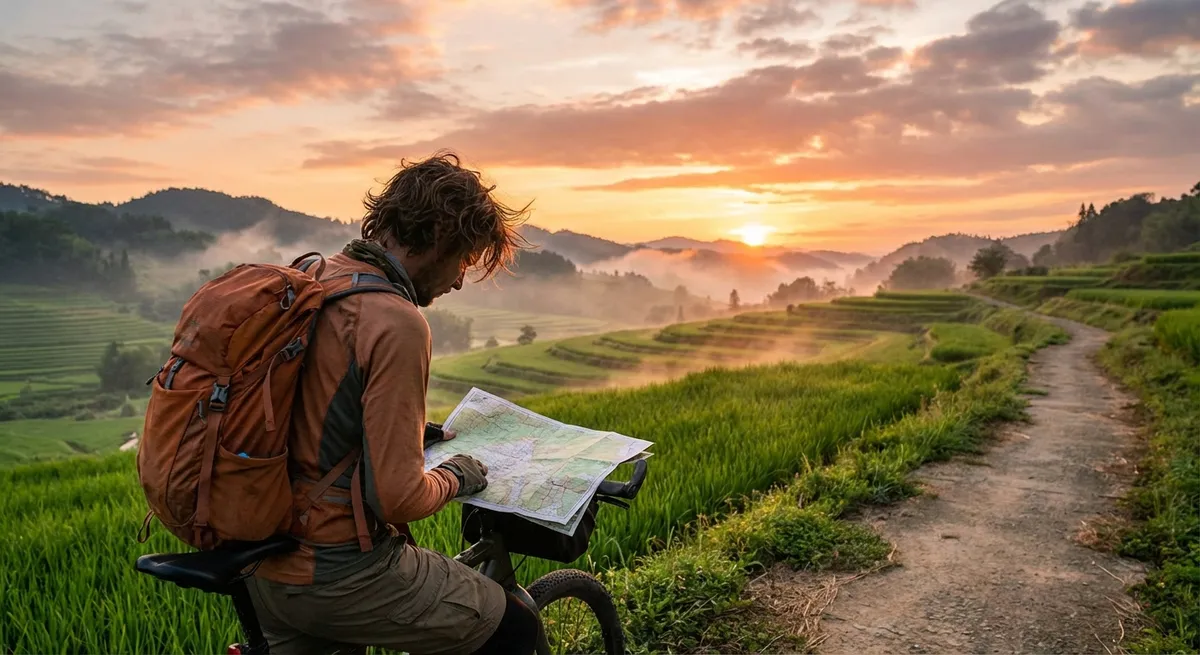
This guide is your launchpad: five field-tested active travel tips, each paired with destination ideas that make your training feel less like “exercise” and more like a daring side-quest. Lace up; the globe is your playground.
Rebuild Your Itinerary Around Sunrises and Sunsets
Your trip hits differently when your training syncs with the sky. Dawn and dusk deliver cooler temps, fewer crowds, and that electric feeling of being awake while the world is still stretching. Instead of cramming a random workout into the middle of the day, frame your entire itinerary around those golden windows.
In places like Lisbon, Portugal, you can power-walk or run the miradouros (hilltop viewpoints) at sunrise, using the city’s steep alleys as natural interval training, then slide into café culture once the tourists wake up. In Queenstown, New Zealand, hit the lakeside trails at first light when the water is glass and the mountains paint your warm-up with color. Even in urban hubs like Tokyo, looping around the Imperial Palace moat at sunrise feels like private access to a global capital. When you let the sky dictate your training, every session feels cinematic—less like a chore, more like a scene you’ll replay in your mind for years.
Turn Local Terrain Into Your Training Partner
Forget treadmills. The most functional, full-body training tools are already rooted in the ground. Stairs, sand, cobblestones, forest paths, and snowfields all shape your muscles in ways gym machines never can. The trick is to read the terrain like a coach: What does this landscape want me to do?
In Cinque Terre, Italy, the steep stone staircases connecting villages become quad-burning climbs and calf-focused descents. On Costa Rica’s Pacific coast, beach runs on soft sand turn into low-impact strength work that challenges your stabilizers while the surf cools your ankles between intervals. In the Swiss Alps, hiking routes with varied elevation let you alternate between power hiking, light jogging, and loaded pack marches. Approach every slope, step, and surface as a training cue: sprint that short hill, lunge the length of a quiet promenade, or use driftwood or rocks for simple strength moves. Your surroundings stop being scenery and start being your training plan.
Use Micro-Challenges to Turn Every Day Into an Expedition
You don’t need a multi-day trek to feel like an explorer. Micro-challenges—small, specific movement missions—turn ordinary travel days into low-key expeditions that layer fitness into your fun. Pick a theme for the day and let it guide your choices.
In a city like Barcelona, challenge yourself to “earn every viewpoint”: no elevators, no shortcuts—only stair climbs to every terrace, rooftop bar, and cathedral tower. In Seoul, aim for a “10-park day,” stringing together pocket parks, riverfront paths, and temple grounds on foot instead of hopping cabs or subways. On Greece’s Cycladic islands, set a “1000-step day” by tracking staircases between ports, beaches, and hilltop churches. These challenges gamify movement; by nightfall, your step count is sky-high, your legs are pleasantly spent, and your memories are stitched together by effort, not Uber receipts.
Pack Like an Athlete, Roam Like a Minimalist
Active travel rewards those who travel light but think like a pro. Every ounce you carry changes how your body moves—on long days, your backpack becomes part of the workout. So pack with intention: you want gear that multiplies your options without weighing you down.
Choose quick-dry, breathable layers and a single pair of versatile training shoes that can handle cobblestones, trail switchbacks, and spontaneous bodyweight sessions in a park. A compact resistance band, jump rope, or light suspension strap can turn any balcony, playground, or bus stop into a strength station. In mountain towns like Chamonix or Banff, a windproof shell and gloves can be the difference between bailing on a ridge hike and pushing on to that life-altering view. In tropical hubs like Bali or Phuket, a light rash guard lets you pivot from beach runs to surf sessions without worrying about sunburn. When your bag is a curated toolkit instead of a portable closet, you move cleaner, faster, and more freely.
Anchor Each Trip With One Big “Signature Effort”
The spine of any unforgettable active trip is a single, bold effort—a climb, paddle, run, or ride that scares you just enough to sharpen your senses. Everything else in your itinerary becomes the support act: the food that fuels you, the mobility work that preps you, the sleep that restores you.
In Peru’s Sacred Valley, that might be a sunrise ascent to a lesser-known viewpoint above Ollantaytambo rather than the usual tourist crush. In Norway’s Lofoten Islands, it could be a ridge hike that finishes with a polar plunge in an icy fjord. On Hawaii’s Big Island, maybe it’s a long, rolling bike ride across black lava fields that forces you to manage effort, hydration, and heat like an endurance athlete. This “signature effort” doesn’t have to be extreme; it just needs to sit at the edge of your current comfort. Train loosely toward it in the days leading up, respect the recovery afterward, and let the accomplishment rewire how you see your own capacity. When you look back, that effort will be the glowing point on the map that defines the entire journey.
Conclusion
Active travel is not about returning home exhausted—it’s about returning home expanded. When you sync your movement with sunrise, let landscapes dictate your training, gamify your days with micro-challenges, pack like an athlete, and anchor each trip with one daring centerpiece, the line between “trip” and “transformation” starts to blur. Your passport fills with stamps, your muscles fill with stories, and your definition of “vacation” evolves into something wilder: a roaming laboratory where you test what your body and spirit can actually do.
The next time you open a map, don’t just ask, “Where should I go?” Ask, “Where do I want to move?” Then go find out.
Sources
- Centers for Disease Control and Prevention – Physical Activity Basics - Guidelines on weekly activity levels and health benefits, useful for planning active travel days
- World Health Organization – Physical Activity - Global recommendations and data on how movement impacts health and longevity
- Harvard T.H. Chan School of Public Health – The Benefits of Physical Activity - Evidence-based overview of how varied physical activity supports overall health
- American Council on Exercise – Exercise Outdoors: Benefits and Tips - Research-backed benefits of outdoor movement and practical advice for training outside
- U.S. National Park Service – Plan Your Visit - Official guidance on safely planning active experiences in U.S. national parks