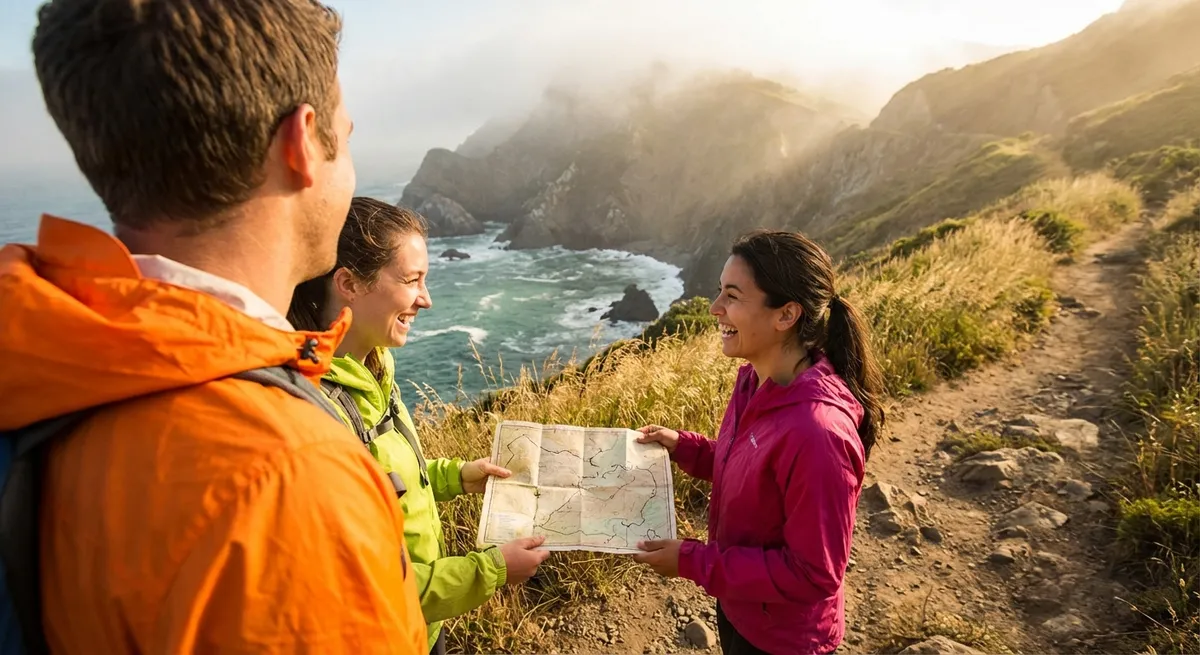
Active Travel: When The Journey Is The Workout
Active travel isn’t about checking off attractions between gym sessions—it’s about letting movement lead your itinerary. Instead of asking, “What should I see?” you start asking, “How can I move through this place in a way I’ll never forget?”
Imagine sunrise in Cape Town, hiking Lion’s Head while the city yawns awake below you. Picture an evening ride along Copenhagen’s harbor, flowing with locals on dedicated bike lanes that feel safer than some sidewalks back home. Or a trail run on volcanic paths in Santorini, weaving between whitewashed homes and cliff‑edge chapels as the Aegean flashes below.
Active travel is:
- Choosing the long, scenic route instead of the shuttle.
- Swapping a passive bus tour for a kayak, a bike, or a pair of trail shoes.
- Letting landscapes—mountains, coastlines, urban staircases—shape your training.
The reward? You don’t come home “needing a vacation from your vacation.” You come home stronger, clearer, and loaded with stories only your muscles truly understand.
Tip 1: Design Your Trip Around One Big Signature Effort
Every active trip deserves a “main quest”—one big effort that anchors the whole journey and gives your smaller adventures a sense of build‑up.
This might be:
- A multi‑pitch climb in Railay Beach, Thailand, after a week of shorter routes.
- A summit push on Mount Batur in Bali, watching the sky catch fire at dawn.
- A 60–80 km bike loop in Mallorca after daily warm‑up rides along the coast.
- A point‑to‑point trail run in Chamonix with the Alps looming like friendly giants.
- Excites you and scares you a little.
- Fits your current fitness with a stretch (not a gamble).
- Matches the environment: think ridgelines in Patagonia, coastal paths in Portugal, forest routes in British Columbia.
Choose a goal that:
Then build your itinerary around progressively longer or more technical efforts that lead up to that one big challenge. You’re not just sightseeing—you’re quietly training, letting each day prepare you for the adventure you’ll remember years from now.
Tip 2: Let Each Destination Shape Your Movement
One of the perks of active travel is that your “programming” can morph with the landscape. Instead of forcing your usual gym routine onto every place, use each destination’s natural strengths.
Some ideas by environment:
Coastal cities & islands
- Turn beaches into your sand‑resistance track: soft‑sand sprints at Bondi in Sydney or sunrise jogging on Copacabana in Rio.
- Use ocean swims or SUP sessions as low‑impact cardio in places like Hawaii’s Kailua or Greece’s Naxos.
- In places like Banff, Zermatt, or Queenstown, prioritize hiking, trail running, scrambling, and hill sprints.
- Use gondola or train access (e.g., Switzerland’s Jungfrau region) to reach high‑altitude trails and do downhill‑focused runs or strength‑endurance hikes.
- Turn staircases into interval sets: think Montmartre in Paris, Kowloon’s hillside steps in Hong Kong, or Lisbon’s stacked alleyways.
- Use public parks for bodyweight circuits—Lumphini Park in Bangkok, Retiro Park in Madrid, or New York’s Central Park become natural outdoor gyms.
- Paddleboarding in Vancouver’s False Creek, kayaking on Slovenia’s Lake Bled, or rowing in Cambridge, UK, build endurance while letting you see a city from its waterways.
Mountain towns & highlands
Urban jungles
Rivers & lakes
By letting each place dictate the dominant movement—climbing, swimming, riding, hiking—you’ll build a more rounded, resilient body and absorb the environment in the most intimate way possible: through effort.
Tip 3: Pack Like an Athlete, Not a Tourist
Your pack is your mobile gear locker. Every item should earn its space by helping you move better, recover faster, or stay safe while you chase bigger efforts.
Consider dialing in a compact “active travel kit” that might include:
- Footwear strategy: One pair of light, responsive trainers that can handle city runs and gym sessions, plus a trail shoe or hybrid for off‑road adventures. In destinations like the Dolomites or the Scottish Highlands, grippy shoes can be the difference between “epic” and “emergency.”
- Minimalist strength tools: A set of resistance bands and a lightweight jump rope fit in any carry‑on and turn hotel courtyards, rooftops, and hostel patios into training spaces.
- Recovery essentials: A small massage ball, compression socks for long flights, and a soft fabric wrap or band that can double as a mobility strap. These become your best friends after back‑to‑back trekking days in places like Peru’s Sacred Valley or Nepal’s Annapurna region.
- Hydration and fuel: A collapsible bottle and a few familiar electrolyte packets or gels reduce your odds of performance‑wrecking dehydration—especially in hot, humid hubs like Singapore or Dubai.
- Light weather armor: A packable shell for alpine towns where sky moods change by the minute, and a breathable sun hoodie for deserts and tropical islands.
When you pack like an athlete, you stop being limited by hotel gyms or random equipment. The world itself becomes the gym, and your bag just carries the essentials that make it sustainable day after day.
Tip 4: Use Local Culture to Enhance Your Training, Not Compete With It
Active travelers don’t have to choose between cultural immersion and physical challenge—in the best trips, they amplify each other.
Swap generic workouts for movement that’s rooted in the destination:
- Practice sunrise yoga on a rooftop in Rishikesh, India, where the Ganges glows below.
- Join a guided tango‑inspired conditioning class in Buenos Aires, blending footwork, balance, and rhythm.
- Learn basic Muay Thai in Bangkok or jiu‑jitsu in Rio, using your training to tap straight into the city’s heartbeat.
- Take a salsa‑dance cardio night in Cali, Colombia, and call it your “interval session” with better music.
Fuel like a local, too, with an athlete’s eye:
- In Japan, lean into rice bowls, grilled fish, and miso soups—clean carbohydrates and protein for long days on foot.
- In Mediterranean hubs like Athens or Barcelona, let olive oil, legumes, grilled seafood, and fresh produce restore you after trail runs or coastal cycles.
- In Vietnam, noodle soups like phở or bún bò Huế make for light yet replenishing meals between rides and hikes.
Let local movement, food, and daily rhythm guide your recovery and performance. You’re not just passing through; you’re syncing your body’s tempo with a new place, at least for a while.
Tip 5: Treat Recovery As Part of the Adventure, Not a Time‑Out
Active travel loads your system in ways you might not fully notice until you hit a wall. New time zones, different foods, odd sleep windows, and unfamiliar terrain all stack stress on your body. If you treat recovery as optional, you’re gambling with your biggest days.
Instead, build restoration into your itinerary as deliberately as your hardest efforts:
- Book a traditional onsen visit in Japan after long hikes in Nikko or Hakone—heat, mineral water, and quiet ritual restore more than your muscles.
- In Iceland, pair glacier hikes or trail runs with soaks in geothermal pools around Reykjavík or the Secret Lagoon.
- Use “slow mornings” in cities like Rome or Kyoto as dedicated stretch, mobility, and breathing sessions before you hit the streets. Ten minutes of focused flow on a balcony can keep tight hips and backs from derailing future mileage.
- Respect sleep like a training session: blackout masks, earplugs, a consistent wind‑down ritual, and, when possible, earlier nights before major efforts like summit days or long rides.
Think of recovery as exploration turned inward. You’ve asked a lot from your body—active recovery days, gentle swims, easy urban walks, and deliberate rest are how you thank it, so you can keep chasing horizons instead of nursing preventable injuries.
Conclusion
Some people collect magnets; you collect miles, summits, staircases, and sweat‑salted memories from corners of the planet most tourists only glimpse through a bus window. Active travel isn’t about perfection or grinding through every day—it’s about weaving movement through your journeys so deeply that the line between “training” and “travel” disappears.
Design trips around a bold objective, let each landscape teach you how to move, pack like an athlete, pull culture into your workouts, and honor recovery as part of the story. Do that, and your passport stops being just a document; it becomes a logbook of the wild, beautiful ways you chose to inhabit your own body across the world.
The map is waiting. Pick a point, lace up, and go find out what your legs—and the land—have to say to each other.
Sources
- Centers for Disease Control and Prevention – Healthy Travel Tips - Guidance on staying healthy and active while traveling, including hydration and fatigue management
- Harvard T.H. Chan School of Public Health – Physical Activity and Health - Overview of the benefits of sustained physical activity, relevant to active travel lifestyles
- American College of Sports Medicine – Hydration and Physical Activity - Detailed recommendations on hydration strategies during exercise, useful for active travelers in varied climates
- Sleep Foundation – Jet Lag and Sleep - Evidence-based advice on managing sleep and recovery when crossing time zones for active trips
- Adventure Travel Trade Association – Adventure Tourism Development Index - Industry perspective on adventure and active tourism trends and destination characteristics