Why the World Is the Best Gym You’ll Ever Train In
When you step outside to move, your senses wake up in a way no treadmill can match. Uneven terrain forces your stabilizer muscles to work harder, natural obstacles become instant training tools, and shifting weather demands real adaptability. Research shows that outdoor exercise can improve mood and lower perceived effort, meaning the same workout can feel easier outside than indoors—while your heart and lungs still work just as hard.
Travel adds another layer: new environments challenge your body and your brain. A sunrise run along Lisbon’s waterfront, stair repeats in the streets of Valparaíso, or bodyweight circuits at a beach park in Rio invite you to explore with purpose. You’re not just ticking off landmarks; you’re building a living, breathing map of places your legs carried you and your lungs conquered.
At its core, active travel isn’t about chasing perfection—it’s about chasing presence. Outdoor workouts forge a deeper connection with the landscapes you cross, the people you meet, and the version of yourself that shows up when the trail tilts up and the air gets thin.
Destination-Driven Sweat: Turning Places Into Training Partners
Every destination has a natural “personality” that can shape your workout. Instead of forcing your usual routine into a new place, let the terrain write your training plan.
In coastal cities like Cape Town or Sydney, beach runs, dune sprints, and oceanfront mobility flows feel almost inevitable. The soft sand punishes your legs in the best way, while the roar of the waves keeps you grounded. Swap machines for movements like walking lunges, bear crawls, and lateral shuffles on the sand for a full-body burn.
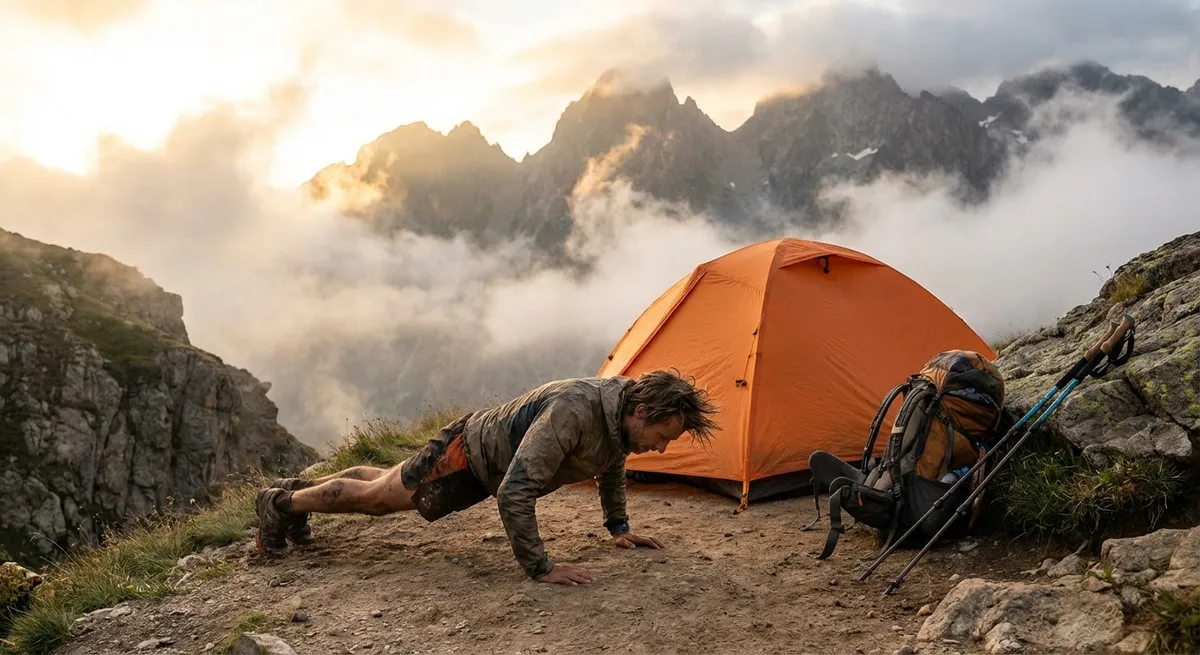
Mountain towns—from Chamonix to Banff—are made for hill repeats, hiking ascents, and trail intervals. Use steep streets or switchback trails for sustained climbs that build power and resilience. Mix fast hiking bursts with easy recovery sections, and you’ve got a rugged interval session that doesn’t need a gym timer.
Urban jungles like Tokyo, New York, or Barcelona become playgrounds of stairs, parks, and riverside paths. Public squares are perfect spots for short, sharp circuits; park benches become step-up platforms and push-up bars. Bridges and waterfronts offer long, flat lanes for tempo runs while you watch the city wake up or wind down.
When you see a place as a training partner instead of a backdrop, every alley, overlook, and boardwalk becomes an invitation to move.
5 Active Travel Tips for Fitness Adventurers
1. Build a “Go Bag” That Travels Lighter Than a Dumbbell
Pack a minimalist training kit that disappears in your backpack but unlocks full-body sessions anywhere. A compact resistance band, mini loop band, and lightweight jump rope can transform even the smallest hotel balcony into a training zone. Bands add load for rows, presses, and hip work when you don’t have weights, while a jump rope turns any courtyard into a conditioning arena.
Before you leave, test a 20-minute “anywhere workout” using only what’s in your go bag. That way, when you’re jet-lagged in a new city, you’re not improvising—you’re executing a familiar plan in an unfamiliar place, which keeps you consistent without draining decision-making energy.
2. Use the Terrain as Your Coach, Not Your Enemy
Don’t fight the local landscape; lean into it. If you’re in a hilly village in the Dolomites, skip the flat steady-state run and design a short hill-focused workout: 30–60 seconds of climbing followed by a walk back down, repeated for 20–25 minutes. In pancake-flat destinations like the Netherlands, shift to endurance runs, cycling, or speed-focused intervals along canals or coastal paths.
Even surfaces that seem “annoying”—cobblestones, sand, steps—can enhance your training. Cobblestones demand balance and ankle stability; sand strengthens your ankles and calves; stone steps in historic old towns are tailor-made for plyometrics and power. Respect the terrain, scale the intensity to your fitness level, and let the environment guide how hard you go.
3. Turn Sightseeing Into a Moving Circuit
You don’t have to choose between exploring and training—blend them. Pick a route that strings together viewpoints, murals, plazas, or temples, and layer in short movement “checkpoints” along the way. For example: every time you reach a scenic overlook, do a quick micro-set—10 squats, 10 push-ups, 20 seconds of high knees.
In cities with long promenades—like Nice, Vancouver, or Buenos Aires—you can segment your run or walk based on landmarks: accelerate between two piers, slow to a recovery pace to the next plaza, then stop for a mini strength break. This style of movement keeps your workout mentally fresh, embeds memories in your body, and turns your training into a living tour map.
4. Anchor Your Day With One Non-Negotiable Movement Ritual
Travel is unpredictable: trains are late, weather shifts, local feasts run long (as they should). Instead of clinging to a full workout schedule, choose one simple, non-negotiable ritual to ground each day. It might be a 15-minute sunrise mobility flow, a set number of daily steps, or a short strength circuit before your morning coffee.
If you’re exploring places like Kyoto, Queenstown, or Lisbon, an early walk, run, or stretch session lets you experience the city before the crowds. This low-friction ritual becomes your anchor; everything after it is a bonus. Over time, these small daily commitments add up to a powerful base of consistency, no matter how chaotic your itinerary looks.
5. Chase Experiences, Not Just Metrics
There’s a time and place for strict training plans—but when you’re on the road, leave room for bold, experience-driven movement. Sign up for the local sunrise hike in Patagonia, join a beach boot camp in Santorini, rent a bike in Amsterdam, or try surf lessons in Costa Rica. These sessions might not fit neatly into your spreadsheet, but they expand your skill set, challenge new muscle groups, and etch unforgettable memories into your training story.
Instead of obsessing over perfect splits or gym PRs, ask yourself: “What’s the most adventurous way I could move here today?” Maybe it’s a slow, sweaty stair climb to a hilltop fortress with a panoramic view, or a spontaneous trail run in a national park you’d never heard of until yesterday. Let your curiosity and courage steer the plan, and you’ll come home fitter in ways your watch can’t measure.
Sample Outdoor Workout Ideas in Iconic Settings
To spark your imagination, here are ways you might train in three very different destinations—no gym membership required.
Coastal Town (e.g., Lagos, Portugal)
Start with an easy jog along the cliffs as the sun lifts over the Atlantic. Find a quiet overlook or stretch of sand and run through a 25-minute circuit: walking lunges, plank variations, jump rope intervals, and banded glute work. Cool down with a barefoot walk at the water’s edge, letting the cold waves hit your calves to jumpstart recovery.
Alpine Base (e.g., Innsbruck, Austria)
Warm up with a brisk walk from town toward a nearby trailhead. Hike uphill for 20–30 minutes at a steady pace, then add short bursts of faster effort on selected segments. At a viewpoint clearing, use a bench or rock for step-ups, incline push-ups, and single-leg squats. On the descent, focus on control and foot placement—your quads and ankles will thank you later.
Big City Hub (e.g., Singapore)
Head to a waterfront path or large park at dawn to beat the heat. Use light poles or park features as markers: run hard between two lampposts, walk to the next, and repeat. Drop into pockets of shade for mini bodyweight blocks—air squats, dips on benches, and core work on the grass. Finish with an easy walk through a local market to refuel with something fresh and regional.
Conclusion
Your passport isn’t just a document; it’s a training partner. Every new stamp is an invitation to move differently—to climb higher, run further, breathe deeper, and see more than you ever would from a hotel treadmill. Outdoor workouts on the road don’t ask you to sacrifice adventure for fitness; they fuse the two into one powerful, unforgettable rhythm.
Let mountains set your pace, oceans cool your sweat, and city skylines mark your intervals. Pack light, move boldly, and let each destination leave its mark not only on your memories—but on your muscles, lungs, and confidence. The world is calling; answer it with your heartbeat.
Sources
- Harvard Health Publishing – The Great Outdoors: Be Active in Nature - Overview of physical and mental health benefits of outdoor exercise
- American Council on Exercise (ACE) – The Benefits of Exercising Outdoors - Explores how outdoor training impacts mood, effort perception, and performance
- Centers for Disease Control and Prevention – Physical Activity Basics - Evidence-based guidelines on activity levels for health and travel planning
- Mayo Clinic – Fitness: Tips for Staying Fit While Traveling - Practical strategies for maintaining movement routines on the road
- National Park Service – Plan Your Visit - Guidance on safe, active exploration in outdoor and park environments