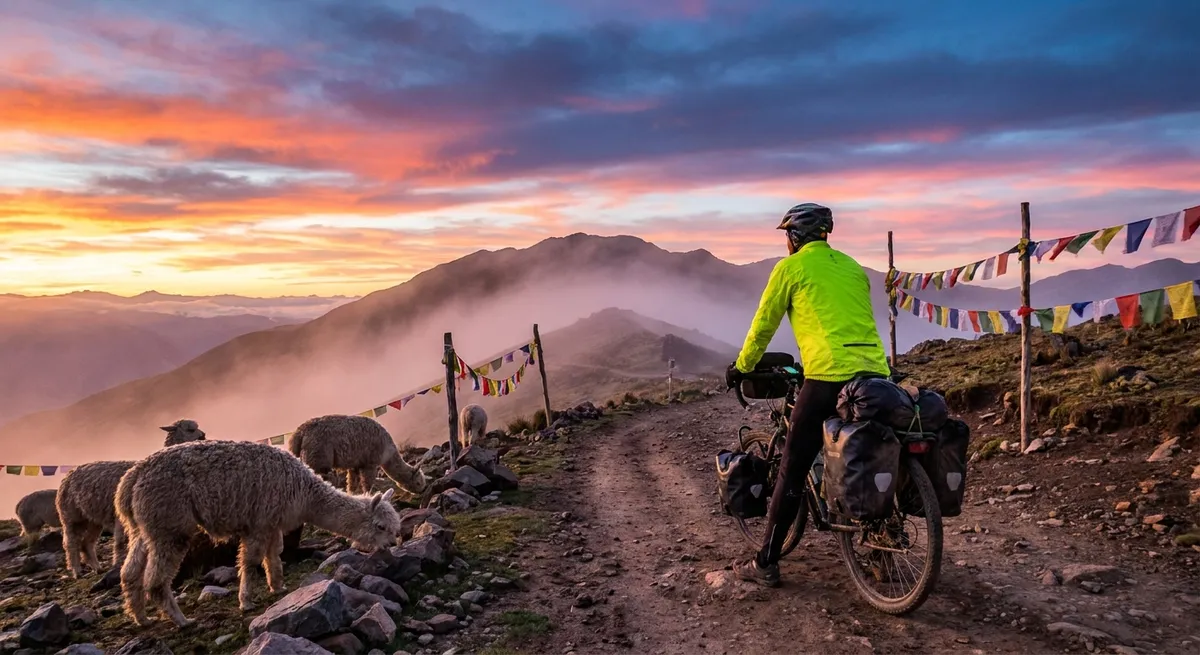
Why Active Travel Hits Different
Active travel isn’t just “vacation with a workout.” It’s a mindset that turns the journey itself into training ground, playground, and teacher.
Instead of skimming a city from bus windows, you feel its pulse on a sunrise run past locals opening shop fronts, or on a bike ride where every climb rewards you with a rooftop view of the world. Your recovery meals become cultural deep dives—rice and dhal in Nepal after a ridge trek, ceviche in Peru after an ocean kayak, fresh pasta in the Dolomites post-climb.
Because you’re moving through landscapes under your own power, you connect more deeply with where you are: the thin air of a high-altitude village, the jungle humidity clinging to your skin, the crisp silence of a pine forest blanketed in snow. Your body becomes your passport, and each drop of sweat is a stamp saying, “I was really here.”
From cycling the windswept coasts of Portugal’s Algarve to trekking the volcanic routes of the Azores, from trail running above Cape Town’s Atlantic cliffs to stand-up paddling in Croatia’s island labyrinth—active travel leaves you stronger, sharper, and more alive than when you left home.
Tip 1: Let Terrain Train You
When you travel actively, the landscape becomes your coach, your gym, and your test all at once.
In the Swiss Alps, long ascents become natural interval sessions—power hikes up, controlled jogs down—teaching your legs resilience and your lungs patience. In Bali, surfing is a full-body strength and cardio workout disguised as play: paddling torches your shoulders and core, while popping up on the board spikes your power output in an instant. Desert hikes in Utah or Jordan demand strategic pacing, heat management, and hydration discipline, forcing you to become smarter about how you move.
Before you go, look at your destination’s topography: mountains, coastlines, deserts, forests, or cities. Plan your movement around what the terrain naturally offers instead of forcing a rigid gym-style routine. In a flat city like Copenhagen, bike everywhere and weave in sprints between canal bridges. In a hill-laced spot like Medellín, turn staircases and steep streets into impromptu hill repeats. The more you harmonize with the landscape, the fitter—and more attuned—you become.
Tip 2: Anchor Your Days With a “Movement Ritual”
On the road, your schedule can spin into beautiful chaos—overnight trains, street food detours, unexpected invites from new friends. A simple movement ritual each day keeps your fitness and energy anchored without killing the spontaneity.
In Tokyo, that ritual might be a 20-minute dawn run around the Imperial Palace moat before the city explodes into neon motion. In Costa Rica, it could be a beach mobility flow and short bodyweight circuit in the sand at sunrise. Hiking in Patagonia? Use a 10–15 minute warmup each morning—lunges, hip openers, ankle mobility, light core—to prime your body for long, uneven miles.
Pick a time you can defend—even if it’s early morning—and choose a short, repeatable routine you can do in a hotel room, on a balcony, or by a lakeshore. Think: 5 minutes of joint mobility, 10 minutes of bodyweight strength (push-ups, squats, planks, glute bridges, single-leg balance), 5 minutes of stretching or breathwork. This ritual becomes your portable home base; no matter where you sleep, your body knows the rhythm.
Tip 3: Chase Experiences, Not Just Workouts
The most unforgettable active travel days don’t feel like training blocks on a spreadsheet; they feel like stories you can’t stop telling.
Instead of “doing cardio,” you kayak along Norway’s fjords between sheer cliffs and waterfalls, feeling awe work harder on your heart than any treadmill setting. Instead of “leg day,” you climb the stone steps of Machu Picchu or hike sections of the Camino de Santiago, where each step is soaked in centuries of pilgrimage and human grit. Rather than “upper body strength,” you go rock climbing in Railay Beach, Thailand, pulling yourself up limestone cliffs as long-tail boats glide across emerald water below.
When planning your trip, list three to five active experiences you’d be proud to remember: “Watch sunrise from a mountain peak,” “Swim in open water at least once,” “Cross a border by bike,” “Complete a multi-day trek.” Then build in smaller daily movements around these big moments. You’ll come home with memories and photos that also happen to be some of the best training sessions of your life.
Tip 4: Train Smart for the Adventure You’re Actually Taking
Your body doesn’t care how many burpees you can do if your trip is all about stair-heavy temple climbs, long trekking days, or multi-hour bike rides. Aim your training at the demands of the trip, and the adventure will feel like an epic reward instead of a painful shock.
Heading to the Himalayas or the Andes for high-altitude trekking? Focus your prep on longer, low-to-moderate intensity hikes, stair climbing with a pack, and building a rock-solid aerobic base. Visiting a coastal surf town in Portugal, Costa Rica, or Morocco? Add shoulder stability work, core strength, and short high-intensity sprints to mimic paddling bursts and pop-ups. Planning a cycling-heavy journey in the Netherlands or along Europe’s river routes? Spend time in the saddle at home: longer weekend rides, plus some tempo efforts to handle headwinds and longer days.
Three key pillars to tune before you go: endurance (so you can move for hours), resilience (strong joints and connective tissue to handle new surfaces and loads), and recovery (sleep, mobility, and nutrition habits you can maintain on the road). The better you prepare, the more bandwidth you’ll have to enjoy the views, culture, and spontaneity instead of just surviving the effort.
Tip 5: Fuel Like an Athlete, Eat Like a Traveler
Active travel burns more energy than you think—especially when you’re walking 20,000 steps through cobbled streets, lugging a pack, and squeezing in hikes, swims, or rides. To enjoy it all without crashing, you need the brain of a performance athlete and the heart of a curious foodie.
In Mediterranean destinations—Spain’s Costa Brava, Greece’s islands, Italy’s Amalfi Coast—embrace local staples like olive oil, fish, legumes, whole grains, and fresh produce for steady energy and anti-inflammatory benefits. In Southeast Asia, use rice, noodles, vegetables, tofu, and lean meats to fuel long activity days, and hydrate aggressively in the heat with water and electrolytes (coconut water can help, but don’t rely on it alone). At altitude in places like Peru, Nepal, or Colorado, prioritize complex carbs, electrolytes, and regular snacks to keep your energy constant.
Build three simple rules: drink water early and often, weave protein into every meal to help your muscles recover, and carry portable fuel (nuts, fruit, energy bars) for when adventure stretches longer than expected. Say yes to the local specialties—but think of them as fuel and story, not just indulgence. Your legs will thank you at the top of the next climb.
Destination Sparks: Where to Move Next
If your passport is itching and your training shoes are already by the door, aim your next journey where movement and landscape naturally collide.
Consider the Dolomites in Italy for rifugio-to-rifugio trekking and via ferrata routes that turn hiking into a vertical playground, rewarded by mountain huts serving hearty, energy-dense meals. Head to New Zealand’s South Island for multi-day “Great Walks” that thread across alpine passes, fjords, and ancient forests in a single itinerary. Explore Slovenia, where you can trail run in Triglav National Park in the morning and paddle the emerald Soča River by afternoon.
If cities call to you, seek movement-first metros: run the seawall in Vancouver, spin along Berlin’s vast cycle network, or join a sunrise running crew along Rio de Janeiro’s Copacabana. Or keep it closer to home: choose a region you’ve only ever driven through and decide you’ll cross it by foot, bike, or paddle this time. The destination is your canvas; your movement is the story you paint across it.
Conclusion
Active travel is the art of letting the world shape your fitness and your perspective at the same time. When you walk, run, ride, climb, and paddle your way through a place, you don’t just “see” it—you feel it in your lungs, legs, and heartbeat. You return home with more than photos: you bring back a stronger body, a sharper mind, and a deeper connection to the planet you just crossed under your own power.
Pack your curiosity. Pack your grit. Pick a place that excites and slightly intimidates you, then let every mile, wave, and summit carve a new version of you. The world is waiting—and it moves.
Sources
- Centers for Disease Control and Prevention – Physical Activity Basics - Overview of health benefits and guidelines for physical activity, useful for planning safe activity levels while traveling
- American College of Sports Medicine – Hydration Guidelines - Evidence-based recommendations on staying hydrated during exercise and in hot environments
- Harvard T.H. Chan School of Public Health – Healthy Eating Plate - Practical framework for building balanced, nutrient-dense meals on the road
- U.S. National Park Service – Hiking Safety - Official guidance on trail preparation, pacing, and safety for hiking-centric trips
- International Association for Medical Assistance to Travellers – Altitude Sickness - Detailed information on recognizing, preventing, and managing high-altitude illness for mountain adventures