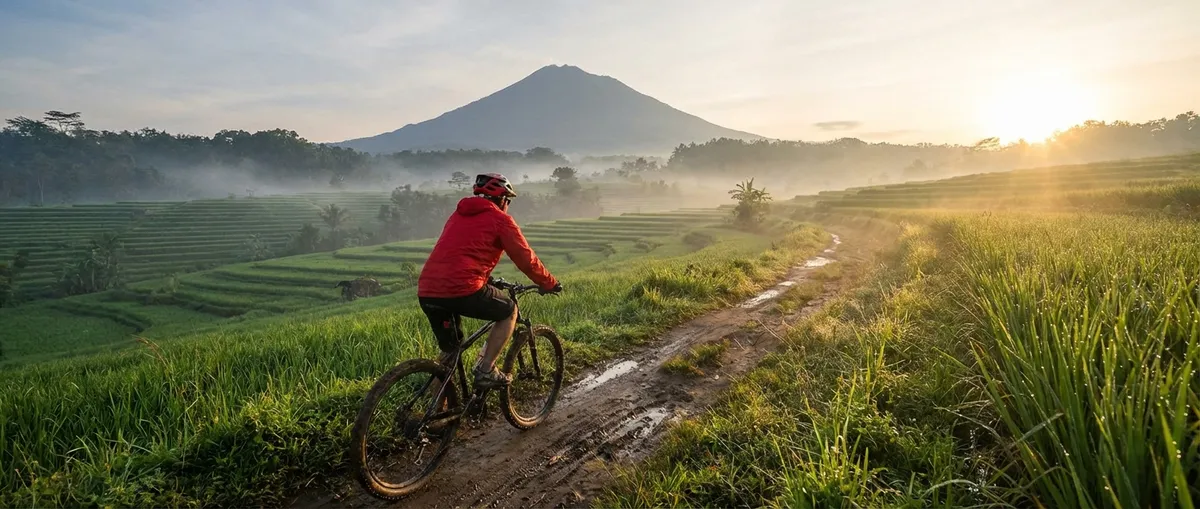
Why Active Travel Hits Deeper Than a Regular Trip
When you explore with your body, every moment sticks sharper in your memory. The hill you bike up in Mallorca, the pre-dawn run along Rio’s Copacabana, the glacier hike in New Zealand — they’re not just photos on your phone, they’re imprinted in your muscles.
Active travel blends three things that humans are built for: movement, novelty, and nature. Research shows that physical activity boosts mood and brain health, while new environments challenge your senses and spark creativity. Put those in motion together and you get a trip that doesn’t just entertain you — it transforms you. Instead of returning home needing a “vacation from your vacation,” you arrive with better endurance, deeper confidence, and fresh respect for what your body can carry you through.
Tip 1: Turn Your Base Into a Training Playground
Skip the mindset of “gym or nothing.” Your destination is your training ground — if you know how to see it.
Choose a base that gives you natural “routes” instead of just views: a hillside town above Italy’s Amalfi Coast, a coastal village in Portugal’s Algarve, or a high-altitude city like Cusco, Peru. Stairs become interval workouts, steep alleyways are built-in hill sprints, and beaches are your sand-resistance training zone.
At sunrise in Santorini, you can turn the whitewashed steps between Oia’s terraces into a stair-climb circuit. In Cape Town, Lion’s Head is a pre-breakfast hike that doubles as cardio and a front-row seat to the city glowing awake. The key is to scout your surroundings like an athlete: look for elevation, open space, safe paths, and natural obstacles — then build your daily “route ritual” around them.
Tip 2: Pursue One Iconic Local Adventure Everywhere You Go
Make a pact with yourself: every destination gets at least one signature, fully-immersive active adventure.
In Norway, that might be kayaking between fjord walls that rise like stone cathedrals. In Japan, it could be cycling the Shimanami Kaido island-to-island route, stopping at tiny cafes and shrines along the way. In Costa Rica, it may be zip-lining over rainforest canopy before trekking to a hidden waterfall pool.
Ask locals what their city’s “must-move” experience is — not just what tourists normally do. You’ll often discover breathtaking hikes just beyond the main viewpoints, lesser-known bike circuits, or local running clubs that welcome visitors. This single, anchor adventure becomes the story that defines your trip — and the standard you’ll chase on the next one.
Tip 3: Train With the Clock, Not Just the Map
Time can be your most powerful training tool on the road. Instead of obsessing over distance, use time-based efforts so you can adapt to terrain, weather, and jet lag.
Design your days around movement windows that anchor your travel rhythm: a 20–30 minute morning wake-up run or walk, a mid-afternoon bodyweight session, or an evening “sunset slow-down” walk to stretch out your legs. In places like Buenos Aires or Barcelona, those golden-hour strolls can easily turn into impromptu circuits — a park bench for step-ups, tree-lined paths for strides, playground bars for hanging holds.
In high-altitude destinations like La Paz or Quito, time-based training lets you scale intensity and monitor how your body is coping while you acclimate. Maybe it’s 15 minutes of easy uphill walking today, extending to 30 as you adapt. You’re not chasing numbers; you’re training responsiveness and resilience in real time.
Tip 4: Pack Like an Athlete, Explore Like a Local
Your gear can either weigh you down or set you free. Pack with a “move-first” mentality.
Bring lightweight, high-mobility essentials: trail shoes that can handle cobblestones and dirt paths, quick-dry layers for unexpected rain or post-ocean dips, and a compact resistance band or jump rope for instant workouts in tiny hotel rooms. A small, close-fitting daypack with chest and waist straps turns any city walk or coastal ramble into a loaded ruck that quietly builds endurance.
Then match your movement to the local rhythm. In Amsterdam or Copenhagen, blend in by renting a bike and commuting like a local on two wheels — your quads will feel it by dusk. In Bangkok or Hanoi, early-morning walks or runs before the chaos hits give you a raw, quiet version of the city few visitors see. Gear is there to support that immersion, not separate you from it.
Tip 5: Let Food Be Fuel and Adventure
Active travel burns through energy fast — which is the perfect excuse to turn every meal into a refuel mission with a side of cultural exploration.
Instead of defaulting to familiar chain spots, seek out local markets and family-run restaurants. In coastal Greece, plates of grilled fish, olives, and salads dripping with olive oil recharge your muscles with healthy fats and protein. In Vietnam, a steaming bowl of phở after a long morning ride hits like jet fuel. In Mexico City, fresh fruit stands, tacos al pastor, and pozole can power an afternoon urban hike without weighing you down.
Use your movement as a compass for what and when you eat: heavier traditional dishes after your longest efforts, lighter meals before hikes or swims, and plenty of local fruits, nuts, and yogurt as on-the-go snacks. Hydration matters even more when you’re moving hard — refillable bottles, frequent water breaks, and electrolyte packets will keep you exploring instead of crashing.
Building a Life That Feels Like an Expedition
The real magic happens when active travel stops being a one-off escape and starts shaping how you live at home. You begin scanning your own city for stair routes, sunrise vantage points, waterfront paths, and weekend “micro-expeditions.” You take the mindset you found on a Patagonian trail or a Balinese rice-terrace run and apply it to your daily routine.
You stop asking, “Where can I go to get away?” and start asking, “How far can I go — on this body, in this lifetime?” The answer grows with every climb, every paddle, every jet-lagged sunrise session you choose to show up for. The world doesn’t just look bigger; you do.
Pack your curiosity, lace up something you can move in, and step into your next trip with intention: not as a spectator, but as a fully-engaged, breathless participant. The planet is out there, wide open — and it moves with you when you move through it.
Sources
- World Health Organization – Physical Activity Facts - Overview of health benefits of regular movement, supporting the case for active travel
- Harvard T.H. Chan School of Public Health – Benefits of Physical Activity - Explains how exercise boosts mood, brain health, and longevity
- Centers for Disease Control and Prevention – Travel Health & Hydration - Guidance on staying healthy and hydrated while traveling
- U.S. Department of Health & Human Services – Physical Activity Guidelines - Evidence-based recommendations for movement that can be applied to active trips
- National Park Service – Hiking Tips - Practical safety and planning advice relevant to outdoor adventures worldwide