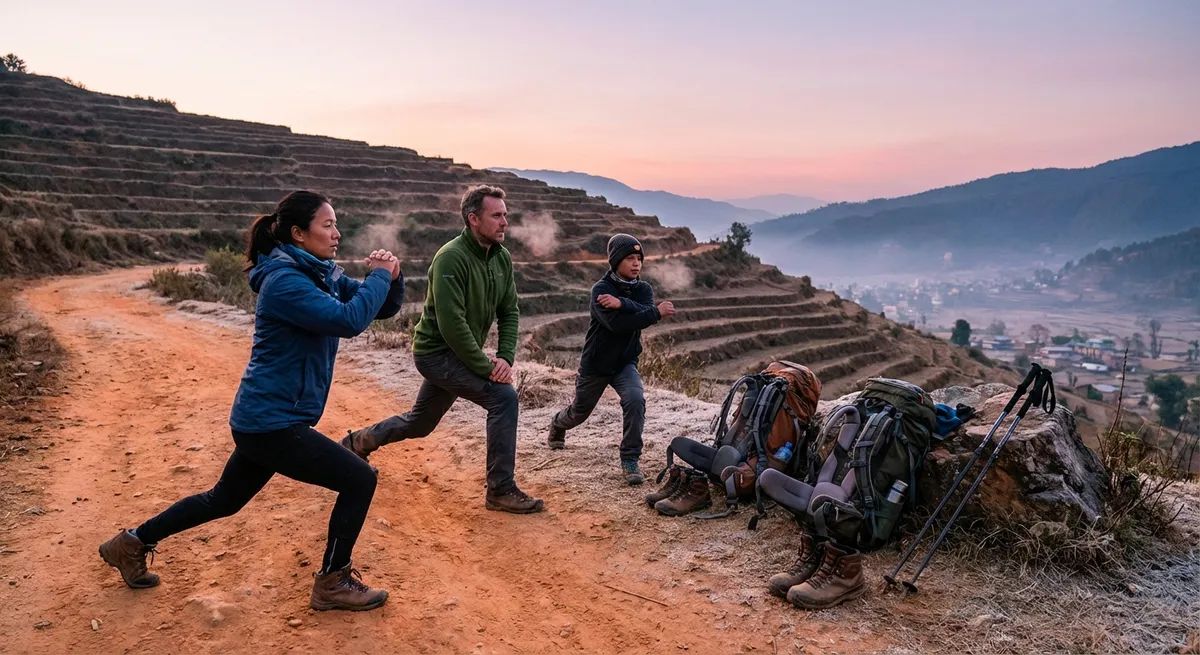
Redefine “Tourist Mode” as “Trail Mode”
Tourist mode stands in line. Trail mode takes the long way on purpose.
Instead of asking, “What’s there to see?” start asking, “What’s there to move through?” In Lisbon, that might mean challenging your legs on the city’s steep, cobbled hills instead of hopping every tram. In Kyoto, it’s walking between temple districts instead of chaining taxis, letting the rhythm of your steps sync with the city’s quiet backstreets. In Vancouver, swap a bus tour for the seawall loop around Stanley Park, feeling the Pacific wind push you forward.
Trail mode is a mindset: you treat every day like a mini-expedition. You pack a small day bag, pick a rough route, and follow it on your own power—on foot, by bike, or even by paddle if your destination allows. Your heart rate becomes your guidebook. The payoff? You see the in-between spaces most travelers miss: the corner café with the best espresso, the alley bursting with street art, the silent lookout where the city spreads out below you like a promise.
Tip 1: Build a “Micro-Adventure” Into Every Itinerary
Micro-adventures are bite-sized quests: 60–180 minutes of deliberate movement woven into your trip.
Instead of planning only “big days” (full-day hikes, long cycling tours), commit to at least one micro-adventure for every travel day. In Rome, that could be a sunrise run past the Colosseum before the crowds swallow it. On Maui, a pre-breakfast swim along the shoreline, tracking fish instead of pool tiles. In Buenos Aires, a brisk evening walk between neighborhoods, capping it off with a quick bodyweight circuit in a quiet park.
The rule is simple: pick a start point, pick a finish point, and move there under your own power with a tiny twist of challenge—an extra hill, a stretch of stairs, or a time goal. These small doses of intentional effort keep your fitness intact while anchoring vivid, place-specific memories. You won’t just remember “that day in Prague”; you’ll remember the burn in your legs from climbing up to Prague Castle in the blue of early morning, with the city still half-asleep.
Tip 2: Train for Terrain, Not Just Aesthetics
Active travel rewards bodies that are prepared for real-world terrain: uneven steps, shifting sand, altitude, and long days on your feet.
A few weeks before your trip, tailor your workouts to your destination. Headed to the Dolomites? Prioritize step-ups, lunges, and loaded carries to mimic elevation and pack weight. Planning a surf-heavy escape to Costa Rica? Build shoulder and core strength with planks, push-ups, and rowing variations. Dreaming of wandering Istanbul’s layered hills and markets? Practice long walks with bursts of stair repeats to simulate those sneaky climbs.
You’re not training for a mirror; you’re training for a landscape. Think of it as “rehearsal” for the way you want to move when you’re out there: scrambling up viewpoints in Cape Town, cycling between villages in the Netherlands, or jogging coastal trails in Croatia. When your body recognizes the demands, you’ll have the energy to say yes to last-minute adventures instead of bowing out because your knees or lungs can’t keep up.
Tip 3: Make Movement Your Map
Navigation doesn’t have to be just about where you’re going. It can also be about how you’ll move to get there.
Pick a neighborhood or natural feature—river, coastline, ridge—and use it as your “spine.” In Paris, follow the Seine on foot or by bike instead of crisscrossing the city underground. In Singapore, link parks and skywalks into a green corridor adventure. In Queenstown, New Zealand, chart your days around lakeside paths and hill trails that loop right back into town.
To keep things fresh, set one movement theme per day: “stairs day” (seek out lookouts, bell towers, city viewpoints), “waterfront day” (rivers, lakes, oceans), or “summit day” (any place with a view after a climb). This gives structure to your exploration without feeling rigid. You’re not just checking sights off a list—you’re drawing your own athletic map across the destination, one powered-by-you line at a time.
Tip 4: Travel With a “Portable Playground” Kit
You don’t need a full gym to turn a balcony, beach, or trailhead into a training ground.
Pack a tiny “playground kit” that fits in any daypack: a resistance band or two, a jump rope, and a light suspension trainer or yoga strap. In a Tokyo business hotel with minimal floor space, that band turns your room into a strength studio. On a long layover, your jump rope turns an empty corner of the terminal into a heart-rate spike. Overlooking the cliffs of Santorini, a strap and a towel become the backbone of a sunset stretching and core session.
Layer in what the environment gives you: park benches become step-up platforms, driftwood logs become balance beams, stone stairs become hill sprints. The goal isn’t to replicate your home workout perfectly—it’s to stay nimble and inventive. Your kit is just the spark; the destination supplies the rest.
Tip 5: Follow the Locals’ Sweat
Every culture has its own language of movement. Tap into it.
In Rio de Janeiro, you’ll see locals training on the sand at sunrise—join a beach workout or copy their drills with short sprints, lunges, and push-ups on the shoreline. In Copenhagen, rent a bike and slip into the commuter flow, moving like a local instead of observing from a bus. In Seoul, parks come alive at night with outdoor gyms and group exercises; mimic a circuit or bring your resistance bands and blend in.
Ask your hosts, guides, or baristas where they move, not just where they eat. Which hill do runners love? Where do cyclists go at the weekend? Is there a community yoga session, a local hike, or a sunrise paddle group? Let their answers pull you to places and perspectives you’d never find in a glossy brochure. You’ll bring home more than photos; you’ll bring back borrowed rituals from worlds away.
Destination Spark: A Few Places That Beg You to Move
To stoke your imagination, consider destinations where the landscape practically dares you to stay active:
- Madeira, Portugal – Levadas (irrigation channels) turned into dreamlike cliffside hiking paths, volcanic peaks, and coastal trails that thread through cloud and jungle.
- Banff & Lake Louise, Canada – Glacial lakes, alpine ridges, and valley floors built for trail running, hiking, and cycling, with vistas that make every climb worth it.
- Auckland & Surrounds, New Zealand – Urban volcanoes, coastal tracks, and island trails reached by ferry—perfect for stitching city and wilderness into one moving story.
- Cape Town, South Africa – Table Mountain hikes, Lion’s Head sunrise scrambles, and cliff-hugging coastal roads, all backdropped by sea and sky.
- Ljubljana & the Julian Alps, Slovenia – Cyclist-friendly city paths, riverside runs, and a quick launchpad into alpine lakes and mountain trails.
None of these places require you to be an elite athlete. They just invite you to show up with curiosity and a willingness to sweat a little for your views.
Conclusion
Active travel isn’t about punishing workouts wedged between tourist stops. It’s about carrying an explorer’s engine inside your chest and letting it pull you deeper into each place—up one more hill, down one more side street, along one more stretch of wild coastline.
Build your micro-adventures. Train for the terrain. Turn movement into your map. Pack your portable playground. Follow the locals’ sweat. Do that, and every trip becomes more than a getaway—it becomes proof that your strongest, boldest self doesn’t live in a gym or a GPS log. It lives wherever you’re willing to lace up, step out, and roam strong.
Sources
- CDC: Physical Activity Guidelines for Adults - Overview of evidence-based recommendations for adult physical activity and health benefits
- American College of Sports Medicine (ACSM): Exercise & Physical Activity - Science-backed information on training principles useful for preparing for active travel
- World Health Organization: Physical Activity Fact Sheet - Global perspective on physical activity, health outcomes, and recommended activity levels
- Parks Canada: Banff National Park Visitor Information - Official guidance on trails, safety, and outdoor activities in Banff for active travelers
- New Zealand Department of Conservation: Day Hikes & Tracks - Detailed info on trails and terrain types to help travelers plan movement-focused adventures