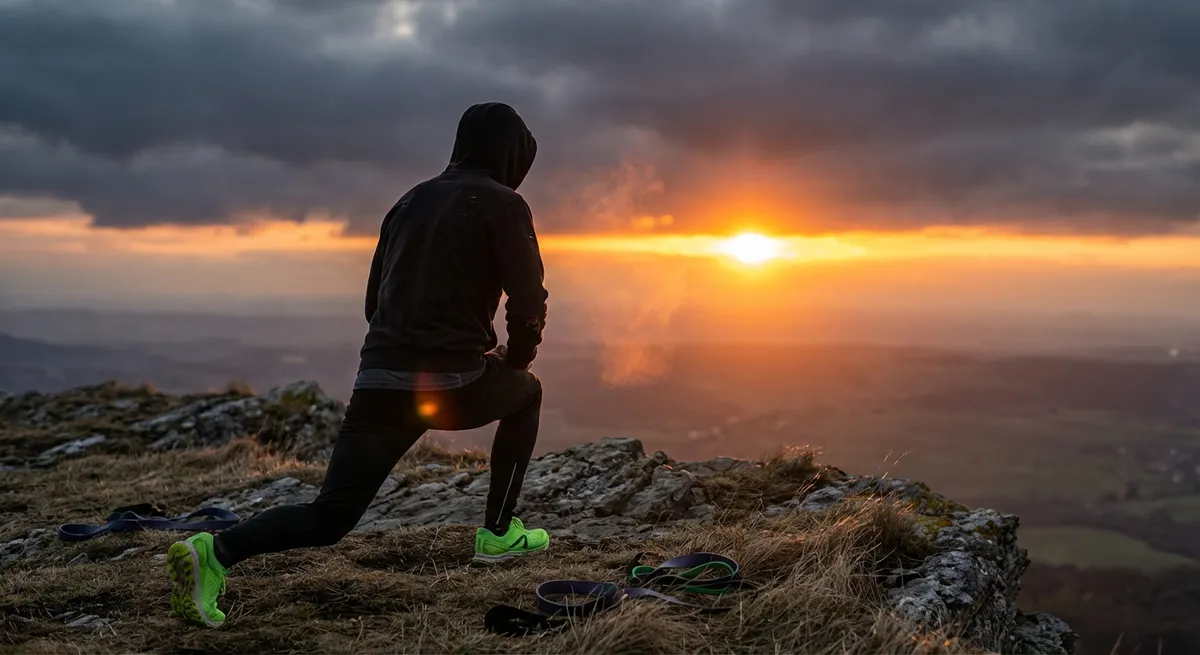
Why Outdoor Workouts Hit Different When You Travel
Gyms are predictable. The road is not—and that’s exactly where the magic is.
Outdoor workouts on the move force your body to adapt: uneven trails fire up stabilizer muscles, changing climates test your stamina, and unfamiliar terrain keeps your brain fully engaged. Research shows that exercising in nature can boost your mood, lower stress, and even make the effort feel easier compared to indoor training. That’s not just fitness—it’s brain chemistry teaming up with the landscape.
Travel adds another layer. High-altitude cities like Cusco or La Paz challenge your lungs in ways a treadmill never will. Coastal towns like Lisbon or Cape Town invite you into stair runs, hill sprints, and sunrise yoga on cliffs. Even urban jungles like Tokyo or Berlin offer riverside paths, park circuits, and hidden stairways that become your personal obstacle course.
Out here, your workout isn’t a break from your adventure. It is the adventure.
Tip 1: Scout the Terrain Like an Athlete-Explorer
Before you land, treat your destination like a course you’re about to race.
Check satellite maps for green spaces, riverfronts, boardwalks, and hills. Look for public parks in cities like Mexico City’s Bosque de Chapultepec or London’s Hampstead Heath—they’re prime ground for circuits, sprints, and mobility work. In mountain regions like the Dolomites or the Rockies, look up short hiking routes you can hit at sunrise for a fasted, heart-thumping climb.
Use local running clubs, tourism boards, and park websites to uncover safe, scenic routes. Many big cities—Sydney, Vancouver, Singapore—publish official trail maps or waterfront paths. Save these on your phone and mark a few “training zones”: one for easy recovery runs, one for stair or hill bursts, one for bodyweight circuits.
The goal: arrive with a mini “movement map” instead of relying on luck or the nearest overcrowded hotel gym.
Tip 2: Pack a Micro-Gym That Disappears in Your Backpack
You don’t need a trunk full of gear to train hard on the road—you need smart, portable tools that multiply what the environment gives you.
Slip these into your bag without sacrificing space for souvenirs:
- Light resistance bands: Perfect for glute activation before a hike in Patagonia, upper-body pull work in a Parisian park, or quick mobility sessions during long layovers.
- Suspension trainer or light travel strap: Anchor it to sturdy trees, railings, or playground bars from Bali beaches to Brooklyn parks for rows, presses, and core work.
- Jump rope: A hotel courtyard in Marrakech, a rooftop in Bangkok, or a harbor promenade in Auckland instantly becomes a conditioning zone.
- Compact yoga or travel mat: For rocky shores in Croatia, dewy grass in the Scottish Highlands, or dusty plazas in Peru where you want a clean base for planks, push-ups, and stretching.
Use benches for step-ups and triceps dips, stairs for intervals, and railings or low walls for incline push-ups. With a little creativity, one park bench becomes a full-body training station.
Tip 3: Sync Your Workouts With the Spirit of the Place
The most unforgettable outdoor sessions don’t just “fit your schedule”—they match the soul of where you are.
- On a Mediterranean island like Mallorca, greet the sunrise with a coastal run and finish with a cold plunge in the sea.
- In a desert landscape like Joshua Tree or Wadi Rum, move early: bodyweight strength and breath-focused yoga while the rocks are glowing and the air is still cool.
- In alpine towns like Chamonix or Queenstown, turn a moderate hike into an interval climb—power up sections, recover with views, and use your descent as a moving meditation.
Ask locals how they move. In Rio, you’ll find beach workout stations and impromptu volleyball games. In Copenhagen, bike paths double as cardio highways. In Seoul, outdoor fitness parks dot the hills. Join in. Your training becomes a bridge into the culture instead of a routine you hide in the hotel room.
Let the environment set the theme: wind for resistance, sand for instability, altitude for lung burn, stairs for power. Your program didn’t change—you just upgraded the backdrop.
Tip 4: Use Active Recovery Days to Explore Deeper
Fitness adventurers don’t have to choose between “rest day” and “see more.” You can do both.
Swap an indoor rest day for low-intensity, high-curiosity movement:
- City wander walks: In places like Lisbon, Istanbul, or Kyoto, pick a neighborhood and walk it end to end. Take the long way, climb every staircase, chase every viewpoint, and let your step count climb without trying.
- Easy bike explorations: Rent a bike in Amsterdam, Montreal, or Taipei and cruise rivers, canals, and side streets. Keep effort conversational and sights wide open.
- Gentle waterfront sessions: In coastal towns, do a 20–30 minute mobility flow by the water. Hips, ankles, and shoulders; nothing max-effort. Let the landscape recharge you.
Active recovery unlocks more of the destination while still honoring your training. You’ll return to your higher-intensity sessions with fresher legs, fewer aches, and a mind full of new maps.
Tip 5: Anchor Your Day With One Non-Negotiable Move
Travel can be chaotic: delayed flights, surprise storms, spontaneous late-night dinners. Instead of clinging to a perfect workout schedule, protect one simple daily ritual that fits anywhere on Earth.
Choose a non-negotiable that travels easily:
- 50–100 air squats before breakfast, whether you’re in a hostel in Hanoi or a cabin in Iceland.
- A 10-minute mobility routine on waking: ankles, hips, T-spine, shoulders, no equipment.
- A sunrise or sunset walk, run, or stair session—just 15–20 minutes tuned into your surroundings.
- A daily “core checkpoint”: 3 rounds of planks, side planks, and dead bugs on your mat or towel.
This single anchor keeps your identity as a mover intact, no matter how unpredictable the day becomes. From there, you can layer in bigger adventures—surf sessions, summit pushes, park circuits—without feeling like you’re “starting over” every time you unpack.
Destination Highlights for Your Next Outdoor Training Adventure
Looking for places where adventure and movement naturally collide? Add these to your bucket list:
- Cape Town, South Africa: Table Mountain and Lion’s Head for sunrise hikes, Camps Bay for beach runs, and oceanside promenades for easy recovery walks with Atlantic views.
- Vancouver, Canada: Seawall runs around Stanley Park, North Shore trails for hill repeats among towering pines, and waterfront stairs to test your legs against the mountains and sea.
- Madeira, Portugal: Clifftop paths, levada walks, and brutal-but-beautiful stair climbs between tiny coastal villages. Perfect for hybrid hiking–running training.
- Queenstown, New Zealand: Lakeside jogs, brutal hill sprints, and nearby trails that pivot seamlessly into mountain biking, climbing, and paddle sessions.
- Tokyo, Japan: Riverside paths along the Sumida or Arakawa, early-morning circuits in parks like Yoyogi, and endless stairs and hills tucked into quiet neighborhoods.
Each of these destinations is more than a backdrop; they’re training partners that push you in new directions—physically and mentally.
Conclusion
Every journey offers landmarks: monuments, viewpoints, famous streets. But the ones your body remembers most clearly are the places where you pushed, breathed hard, and felt absolutely, vividly alive.
Outdoor workouts while traveling aren’t about “burning off the gelato” or “earning your next meal.” They’re about writing your story into the landscape—measured in sunrises chased, hills climbed, oceans plunged into, and miles covered under open sky.
Pack light, move boldly, train with the terrain, and let every new destination reshape what you think your body can do.
The world is waiting outside the gym doors. Step out and meet it.
Sources
- Harvard Health: A prescription for better health — go alfresco - Overview of physical and mental health benefits of exercising outdoors
- American Council on Exercise: Outdoor Workouts Offer Physical and Mental Perks - Explains why outdoor environments enhance training and well-being
- National Park Service: Benefits of Physical Activity in Parks - Details how natural spaces support active lifestyles and overall health
- World Health Organization: Physical activity fact sheet - Evidence-based recommendations for activity levels and health outcomes
- City of Vancouver: Seawall Walking & Biking Routes - Example of an urban destination with curated outdoor routes ideal for travelers who train