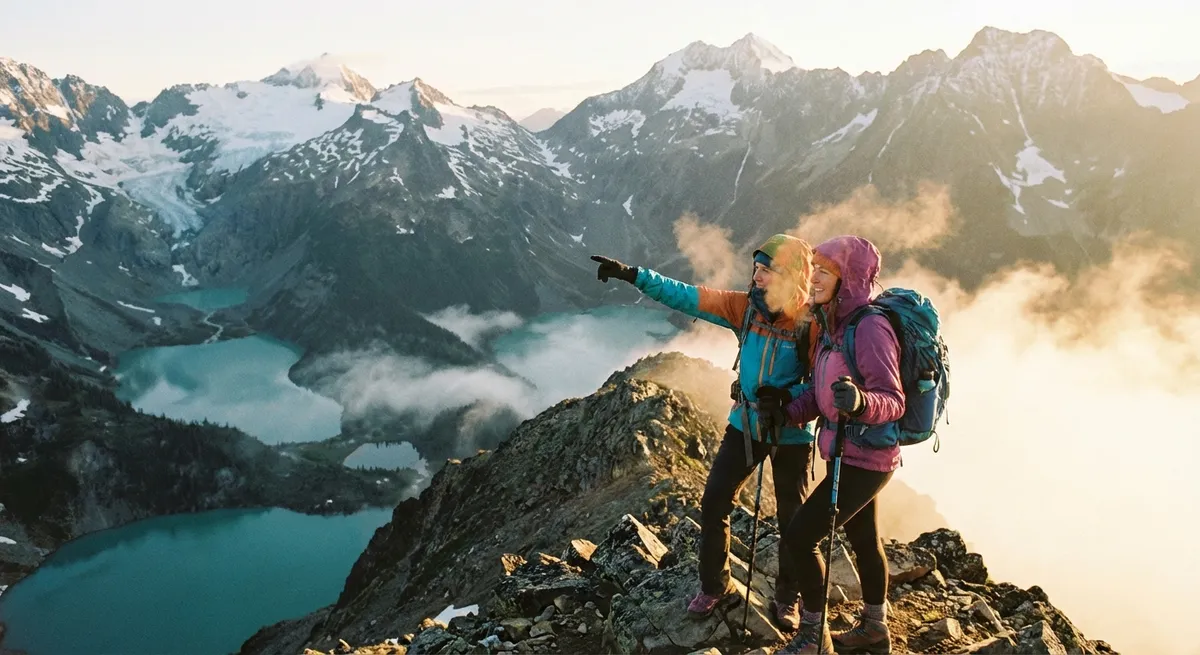
This is your invitation to travel with a summit state of mind—where every destination becomes a chance to sharpen your strength, endurance, and confidence while stacking unforgettable memories.
Why Active Travel Feels Like Freedom
Active travel flips the script on “time off.” Instead of stepping away from your fitness, you take it on tour.
When your body becomes your favorite way to explore, a mountain switchback in Morocco, a staircase in Lisbon, or a coastal trail in New Zealand isn’t just scenery—it’s your training ground. You’re not trapped in a hotel gym waiting for the treadmill to free up; you’re chasing ridgelines, river paths, and backstreets with your heart rate as your compass.
You’ll notice your senses sharpen: you remember cities by the burn in your quads on a steep hill, beaches by how the sand felt under your bare feet, and mountain towns by the altitude in your lungs. The more you move, the more you see—hidden overlooks, quiet alleyways, local sunrise spots that tour buses never reach.
Most importantly, active travel builds a sense of capability that follows you home. After you’ve navigated a pre-dawn run through a foreign city or tackled a high-altitude trek, your everyday challenges start to feel smaller. You don’t just collect photos; you collect proof that you can do hard things in unfamiliar places.
Tip 1: Choose Destinations With Built-In Movement
If you want adventure to feel natural, start by choosing places where movement is part of the landscape and the local rhythm.
Mountain hubs like Chamonix (France), Queenstown (New Zealand), or Banff (Canada) are wired for hikers, trail runners, climbers, and cyclists. Coastal cities such as Rio de Janeiro, Cape Town, and San Diego serve up beach runs, ocean swims, and cliffside walks right from the city edge. Even dense urban centers like Tokyo, Barcelona, and Amsterdam reward you for staying on your feet with walkable neighborhoods, bike lanes, and stair-filled viewpoints.
Instead of asking, “Is there a gym nearby?” ask, “How does this place move?” Does the culture revolve around cycling (Copenhagen), hiking (Swiss Alps), surfing (Bali), or walking (Kyoto)? Let that be your guide. Build your itinerary around local movement: a hut-to-hut trek in the Dolomites, a cycling loop in Mallorca, or a lake swim in the Canadian Rockies.
By picking destinations aligned with your preferred style of activity—trail, pavement, water, or vertical—you make it effortless to log big, satisfying days of movement that feel like play, not obligation.
Tip 2: Pack Like an Athlete, Not a Tourist
Your suitcase can either slow you down or set you free. Think like an athlete on expedition, not a tourist on vacation.
Prioritize gear that multiplies your options: lightweight trail or hybrid running shoes that can handle cobblestones, dirt, and light hiking; quick-dry clothing that you can wash in a sink and re-wear; and a compact daypack with a hydration sleeve or space for water bottles. Toss in resistance bands for hotel-room strength sessions and a small lacrosse or massage ball to roll out tight calves and hips after long travel days.
Lean into layers—especially if you’re chasing elevation or seasons. A packable wind shell or light rain jacket can turn a sketchy weather day into a legendary one. Don’t forget polarized sunglasses and a brimmed hat for high-sun days on water or above tree line, where UV exposure spikes.
If space is tight, ask one question for every item: “Will this help me move more or recover better?” Compression socks for long flights? Yes. Three pairs of bulky shoes? Probably not. The leaner and more intentional your kit, the easier it is to pivot—join an impromptu sunrise hike, rent a bike, or say yes to a canyon swim without worrying if you’re prepared.
Tip 3: Build Your Days Around a Daily “Anchor Adventure”
Instead of forcing workouts into gaps between sightseeing, flip it: let one movement-rich adventure be the anchor of each day.
Your anchor adventure might be a sunrise trail run above Innsbruck, a stair-climb session up to Budapest’s Fisherman’s Bastion, a coastal hike along Portugal’s Algarve, or a stand-up paddle session on a lake in British Columbia. Choose one activity that gets your heart pumping and orients you to the landscape, then build food, exploration, and rest around it.
Morning anchors work best in most destinations: temperatures are cooler, crowds are lighter, and your day can’t derail your training once it’s already done. A dawn hill climb in Medellín or a boardwalk run in Sydney can double as reconnaissance—you spot cafés, viewpoints, and neighborhoods to revisit later at a slower pace.
Use your anchor adventure as a flexible framework instead of a strict rule. If a local suggests joining an afternoon hike to a hidden waterfall or a sunset surf session, swap your plan. The point isn’t discipline for its own sake; it’s consistency in choosing movement as a daily non-negotiable—no matter where your coordinates land.
Tip 4: Treat Food and Recovery Like Your Secret Performance Edge
Active travel can push your body harder than your routine at home—longer days, more steps, heavier packs, new climates. If you want to wake up ready to keep exploring, dial in how you fuel and recover.
Think of local food as both adventure and fuel. In Mediterranean destinations, lean into grilled fish, legumes, vegetables, olives, and whole grains that support long days on your feet. In mountain regions, hearty soups, stews, and whole-grain breads replenish glycogen and warm you up after cold efforts. Seek out fruits and local specialties instead of defaulting to ultra-processed snacks that leave you sluggish.
Hydration is non-negotiable, especially at altitude, in hot climates, or when you’re racking up big step counts exploring cities. Carry a reusable bottle and refill whenever you can; add electrolytes during long hikes, runs, or rides to avoid brain fog and cramps.
Recovery doesn’t need a spa. Elevate your legs against a wall in your guesthouse, roll your feet over a water bottle after marathon walking days, and stretch tight hips and hamstrings before bed. Sleep is your most powerful performance tool: protect it by setting a cut-off time for screens, dimming lights, and, when crossing time zones, trying to align your sleep with local time as fast as possible.
You’re not “soft” for taking recovery seriously—you’re extending the lifespan of your adventure.
Tip 5: Use Local Terrain to Train Skills You Can’t at Home
Travel is your chance to train like a specialist for a few days or weeks at a time, using the terrain and conditions you don’t have access to at home.
In flat cities? Turn urban landscapes into a strength playground—hill repeats on the steepest street you can find, stair intervals on monument steps, and park circuits mixing sprints with bodyweight moves on benches and playground bars. In mountain zones, practice hiking or running at altitude, power hiking steep grades, and descending confidently to strengthen quads and ankles.
Coastal or lakeside? Work on open-water confidence with short, safe swims close to shore, or improve balance and core strength by renting a kayak, surfboard, or paddleboard. In bike-friendly countries like the Netherlands or Denmark, treat cycling as both transport and low-impact endurance training.
Let the destination coach you. Surf towns nurture agility and reaction time on shifting waves. Desert trails teach heat management and pacing. Forest routes dial in your footwork and attention on technical ground. You’ll return home not just fitter, but more versatile—stronger across environments instead of locked into one kind of terrain.
Conclusion
Active travel is a decision to meet the world with your full body, not just your camera lens. When you choose destinations that invite movement, pack like an athlete, anchor your days around adventure, respect your recovery, and train with the terrain, your trips stop being breaks from your fitness—they become accelerators.
The memories that stay with you won’t just be the views; they’ll be the climbs it took to earn them, the miles your legs carried you, and the quiet moments of pride when you realized: I am stronger than I thought, and this planet is my playground.
Your next stamp doesn’t have to be passive. Let it be proof of another summit you chased, another coastline you ran, another city you explored at your own powerful pace.
Sources
- Centers for Disease Control and Prevention – Physical Activity Basics - Overview of recommended activity levels and health benefits of regular movement
- World Health Organization – Physical Activity - Global guidance and data on physical activity and its impact on health
- Harvard T.H. Chan School of Public Health – Staying Active - Explores how consistent physical activity supports long-term health and weight management
- U.S. National Park Service – Hiking Tips - Practical safety and preparation advice for hiking in diverse terrains
- Sleep Foundation – Travel and Sleep - Evidence-based strategies for managing jet lag and protecting sleep while traveling