Why the World Is the Ultimate Gym
Out here, your heart rate monitor isn’t the only thing spiking—your senses are, too. Outdoor workouts immerse you in shifting terrain, changing weather, and unpredictable routes that challenge your body in ways a treadmill never will. Uneven trails fire up stabilizing muscles, sand sprints demand power, and steep city stairs build endurance and strength in one punishing climb.
Training outside also taps into something primal: moving with the earth instead of around it. Research shows that green and blue spaces—parks, forests, shorelines—can reduce stress, elevate mood, and improve mental health, which makes every run, hike, or circuit a reset button for your mind as much as your muscles. You’re not just checking “workout” off a list; you’re layering experience, environment, and effort into one powerful ritual.
Whether you’re weaving through narrow alleys in Lisbon or chasing altitude in the Andes, the planet becomes your coach, your playground, and your resistance equipment all at once. You bring the discipline; the destination brings the challenge.
Destination Moves: Matching Your Workout to the Landscape
Every place you visit is wired for a different kind of training session. Instead of forcing your usual gym routine onto unfamiliar ground, let the destination dictate how you move.
Picture this:
- Coastal escapes – Think sunrise runs on packed sand, barefoot agility drills across the shoreline, and bodyweight circuits near rocky outcrops. Hills leading away from the beach become natural interval-training routes.
- Mountain retreats – Long, grinding hikes morph into low-impact endurance sessions. Add summit squats, boulder step-ups, and loaded pack carries to turn a scenic trek into a strength workout with elevation.
- Urban jungles – City parks, riverfront promenades, and public staircases become HIIT stations. Benches are for Bulgarian split squats, not just coffee breaks. Bridges are perfect for tempo runs and sprint repeats.
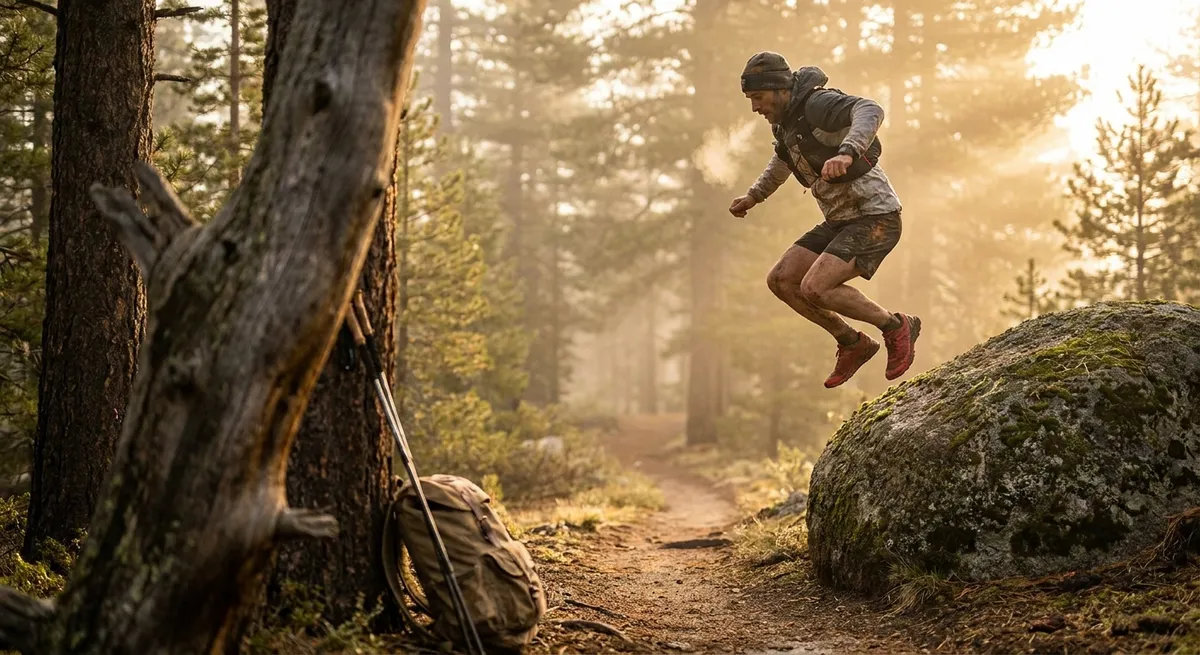
- Forests and national parks – Trail runs, rucksack hikes, log lifts, and fallen-tree balance drills test coordination and proprioception while you navigate roots, rocks, and changing elevations.
- Desert and arid landscapes – Early-morning or twilight sessions with brisk hikes on firm trails, sand shuffles, and short hill climbs amplify your cardio while you practice heat-aware pacing and hydration.
Instead of asking, “Where’s the nearest gym?” ask, “What does this place invite me to do?” Let cliffs suggest climbs, streets suggest strides, and paths suggest progress.
5 Active Travel Tips for the Fit Voyaga Adventurer
1. Pack a Minimalist “Anywhere Workout” Kit
You don’t need a suitcase full of gear to train hard on the road. A compact kit lets you turn almost any spot into a performance zone.
Consider bringing:
- A light resistance band for pulls, rows, and glute activation
- A mini-loop band for hip and core work on the beach or in parks
- A jump rope for quick cardio when space is limited
- A collapsible water bottle that doubles as a hand-weight when filled
- A travel-friendly yoga mat or microfiber towel for ground work
With this setup, a quiet rooftop, a patch of grass, or even a ferry deck transforms into your own outdoor studio. Think 20–30-minute circuits: squats, push-ups, band rows, planks, and sprints or jump rope intervals. No excuses. Just movement.
2. Build Your Itinerary Around Movement, Not Just Monuments
Swap “See the cathedral, then find a café” for “Run to the viewpoint, then reward yourself with local food.” Movement can be the backbone of your travel plans instead of an afterthought.
Ideas to weave activity into your days:
- Choose walking or running routes that pass iconic sights so your workout doubles as a tour.
- Book activities that move you through landscapes—sea kayaking in Croatia, volcano hikes in Guatemala, or cycling between villages in Vietnam.
- Use local transport as a training element—bike-share systems, stair-heavy metro stations, or walking commutes instead of taxis.
When you design your trip around active experiences, every day feels like a micro-expedition instead of a checklist.
3. Train With the Locals (Safely and Respectfully)
Few things deepen your connection to a place like moving with people who call it home. Outdoor group runs, sunrise yoga sessions, and park bootcamps offer authentic, pulse-raising cultural encounters.
How to tap in:
- Search for local running clubs or outdoor fitness meetups on websites and apps (many cities host free weekly runs).
- Look for beach or park yoga in coastal and wellness-focused destinations.
- Check local gyms’ social media for drop-in outdoor classes—from calisthenics to boxing in public squares.
Always prioritize safety: meet in public, well-lit places, stick with reputable groups, and let someone know where you’re going if you’re solo. You’re not just training—you’re learning how the city breathes.
4. Respect Altitude, Climate, and Terrain Like a Pro
Epic scenery can fool you into underestimating the environment. A cliffside path might look like a dream until you realize it’s also a heat trap at midday. Altitude may turn your usual pace into a slog. Training smart keeps your adventure going instead of cutting it short.
Guidelines to move wisely:
- Acclimate gradually at altitude: cut intensity in the first 24–48 hours, hydrate well, and watch for headaches or unusual fatigue.
- Train early or late in hot climates, seek shade where possible, and use light, moisture-wicking clothing.
- Respect technical terrain: slow down on unfamiliar rocks, roots, or sand; shorten your stride; and prioritize good footing over pace.
- Scout routes in advance using maps and local advice so you know distances, elevation, and bailout options.
Your goal isn’t to “conquer” the destination; it’s to move with it. When you adapt to your environment, your workouts become more sustainable—and more unforgettable.
5. Turn Recovery Into Another Adventure
The fitter you are, the more tempting it is to push every single day. But travel multiplies stressors: time zones, new foods, extra walking, and long transit days. Strategic recovery keeps your energy high and your stoke alive.
Try reimagining recovery days as gentler explorations:
- Slow sunrise walks along rivers, coastlines, or hilltop villages
- Easy bike rides through neighborhoods you’d otherwise miss
- Stretching or mobility sessions in a quiet plaza, park, or balcony
- Cold-water dips in lakes, rivers, or the ocean (where it’s safe and allowed) for both circulation and exhilaration
Sleep becomes part of the training plan, not an afterthought. Protect your nights, and your next outdoor session will feel less like a grind and more like a gift.
Sample Destination-Inspired Outdoor Workout Ideas
To spark your imagination, here are a few scenario-based sessions you can adapt to your own trips:
- Harbor City Sunrise Circuit
- 5–10 minutes easy jog along the waterfront
- 3 rounds: 15 bench step-ups, 12 incline push-ups on a railing, 20 walking lunges
- Finish with 4 × 20-second sprints along the promenade, 40 seconds walk between
- Mountain Village Strength Hike
- Choose a moderate trail with steady incline
- Every 10–15 minutes: pause for 15 squats, 10 pack presses, 20 calf raises
- At the summit: plank series (front, side, side) for 30–45 seconds each
- Descend at a controlled pace to train stability and ankle strength
- Beach Power and Mobility Session
- 5 minutes barefoot walk or light jog on firm sand
- 8 × 15-second sand sprints (near the waterline), 45 seconds walk rest
- 10–15 minutes of hip, hamstring, and shoulder mobility work on a towel
- Cool-down in the shallows, letting waves massage your calves
Each session is more than exercise—it’s a way of imprinting the place on your muscles and memory.
Conclusion
Your training doesn’t have to pause when your passport comes out. In fact, your strongest, most alive workouts might be the ones that happen far from your usual routes—on ridgelines instead of treadmills, waterfronts instead of weight rooms, and cobblestone streets instead of rubber flooring.
When you treat the world as your gym, you don’t just maintain fitness on the road—you elevate it. You learn to adapt, to listen to new environments, and to write your story in sweat across continents. Lace up, step outside, and let the horizon decide what today’s workout will be.
Sources
- American Council on Exercise: Health Benefits of Outdoor Exercise – Overview of physical and mental benefits of training outside
- Harvard Health Publishing: Exercising Outdoors Has Many Benefits – Evidence-based look at mood, stress, and health effects of outdoor activity
- Centers for Disease Control and Prevention (CDC): Travel Health – Guidance on staying safe and healthy while traveling, including climate and environmental considerations
- National Park Service: Hiking Safety & Tips – Practical advice for safe, effective hikes and outdoor adventures in varied terrain
- Elevation Outdoor Training and Altitude Acclimatization (UIAA Medical Commission – Expert recommendations on adapting to altitude for physical activity