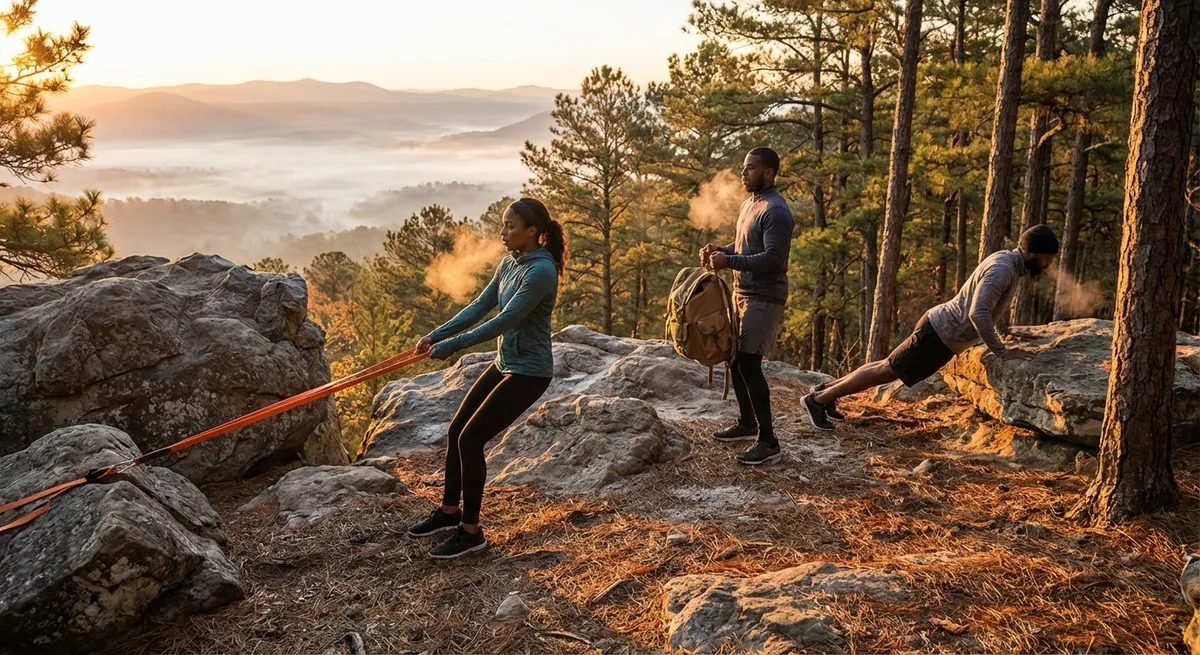
This is your invitation to chase strength across landscapes, to trade treadmills for trails, and to let the world itself be your trainer. Ready to move with the map? Let’s build an adventure-ready routine that fits in your carry-on and unfolds in the open air.
Why Outdoor Workouts Hit Different When You Travel
Training outside in a new place hits your senses all at once: foreign sounds, unfamiliar terrain, new weather, and unexpected challenges. Your balance, focus, and stamina all get tested in ways four gym walls can’t quite replicate.
Outdoor workouts in new destinations:
- Boost your mood and energy by pairing movement with natural light and fresh air, helping to regulate your body clock after long flights.
- Challenge stabilizing muscles on uneven ground—sand, cobblestones, dirt trails, and staircases recruit muscles you usually ignore.
- Improve cardio and endurance as you adapt to different climates and altitudes, from coastal humidity to thin mountain air.
- Deepen your sense of place because you’re not just observing a city or landscape—you’re breathing hard inside it.
- Transform routine into ritual when each morning run or evening circuit becomes the way you greet or say goodbye to a destination.
When you train outside while you travel, your PR isn’t just a number. It’s that hill in Lisbon, that ridge in Queenstown, that seawall in Vancouver. You’ll remember the view as clearly as the effort.
Tip 1: Make Sunrise Your Daily “Check-In” With the City
If you do just one thing on the road, claim the hour when the world is still waking up.
Set your alarm early and step out before the streets fill. Run the waterfront in Stockholm, power walk through misty parks in Kyoto, or flow through a short bodyweight routine on a rooftop in Cartagena. The light is soft, the crowds are thin, and the air feels cleaner—this is when a city shows you its quiet side.
Your sunrise session can be simple:
- 5–10 minutes of walking or easy jogging to warm up
- 10–20 minutes of intervals (e.g., 30 seconds hard / 60 seconds easy)
- 5–10 minutes of stretching or mobility while you watch the sky change colors
This habit keeps your body clock anchored, helps shake off jet lag, and buys you energy for a full day of exploring. More importantly, it plants a flag in your day: no matter what happens with delays, social plans, or unexpected detours, you already showed up for yourself.
Tip 2: Use Local Landmarks as Your Training Equipment
Every destination comes with its own “built-in” workout gear—you just need to see it.
Think like a movement scout:
- Stairs & Steps
- Rome’s side streets, Porto’s riverside steps, the stairways of San Francisco: all perfect for step-ups, stair sprints, calf raises, and walking lunges.
- Benches & Low Walls
- Park benches in Amsterdam, sea walls in Sydney, plaza edges in Mexico City become tools for triceps dips, incline/decline push-ups, box jumps, and Bulgarian split squats.
- Railings & Bars
- Promenade railings or playground bars are ideal for inverted rows, assisted pull-ups, and hanging leg raises (as long as it’s safe and permitted).
- Open Spaces
- Sandy beaches, grassy parks, and wide squares give you room for short sprints, agility drills, and mini circuits.
A quick “landmark circuit” might look like this:
10–15 bench step-ups (each leg)
10 push-ups against a wall or bench
12–15 squats or jump squats
20–30 seconds of stair sprints
30–45 seconds plank on a mat or towel
Repeat 3–5 rounds. In 20–25 minutes, you’ve turned a public space into a pop-up training ground—and you probably discovered a new corner of the city while you were at it.
Tip 3: Let the Landscape Choose Your Cardio
Instead of forcing your usual routine onto a new place, let the geography guide your workout. Shape your training around what the land naturally invites you to do.
Some ideas:
- Coastal Towns –
- Mountain Regions –
- Urban Centers –
- Lakes & Rivers –
Run the shoreline at low tide in Normandy, surf or bodyboard in Portugal, or join a local stand-up paddleboard session in Bali. Sand and water add resistance and challenge your stabilizers.
Hike steep switchbacks in the Dolomites, trail run in the Rockies, or join a guided via ferrata in Switzerland. Uphill effort builds leg strength and cardiovascular power; the descent works your control and coordination.
Tackle hilly neighborhoods in Valparaiso, Rio’s beachfront bike paths, or Tokyo’s park networks for tempo runs, long walks, or neighborhood stair hunts.
Rent a kayak in New Zealand, row on Switzerland’s lakes, or join a local dragon boat team practice in Southeast Asia if schedules allow. These sessions fire your upper body and core while you explore the waterline.
Ask yourself: What do people who live here do outdoors for fun? Tap into that. Not only will you stay active, but you’ll experience the local rhythm of life—morning paddlers, evening runners, weekend hikers.
Tip 4: Pack a “Micro Gym” That Fits in Any Backpack
Your carry-on can double as your training partner. A few lightweight tools multiply your options everywhere from a hostel courtyard to a cliffside lookout.
Consider packing:
- Mini resistance bands – Great for glute activation, hip work, and upper-body pulls in small spaces.
- A long resistance band with handles – Replaces cable machines for rows, presses, and rotations; you can anchor it to a sturdy pole or railing.
- A jump rope – Portable cardio you can use in an alleyway, parking lot, or quiet plaza.
- A lightweight travel mat or packable towel – For core work, stretching, and mobility sessions on rough ground.
With this kit, you can build a full-body routine anywhere:
- Band rows + band chest presses
- Banded squats or lunges
- Jump rope intervals
- Core circuits (planks, side planks, dead bugs, hollow holds)
- Mobility flows for hips, hamstrings, and thoracic spine
Carry this micro gym and you’re never more than 15 minutes away from a solid workout, no matter what your accommodation looks like.
Tip 5: Turn Recovery Days into Moving Exploration
Adventure doesn’t only live in high-intensity days. Smart travelers use “active recovery” to see the world while protecting their joints and energy reserves.
Instead of sitting in a café all afternoon (at least, not the whole afternoon):
- Take a slow, long city walk without a strict plan—wander side streets in Barcelona, cross bridges in Prague, or zigzag through markets in Marrakech.
- Rent a bike in Copenhagen, Montreal, or Taipei and follow local cycling paths at an easy pace.
- Join a gentle outdoor yoga session in a park, on a rooftop, or at the beach—destinations like Costa Rica, Bali, and Thailand often offer these with ocean or jungle views.
- Stroll botanical gardens, castle grounds, or waterfront promenades as a low-impact way to clock thousands of steps while soaking in history and scenery.
These lower-intensity days keep your circulation moving, help with soreness, and let you explore more ground than you’d cover stuck in a car or bus. Recovery turns into curiosity instead of idleness.
Destination Highlights: Where the World Doubles as a Training Partner
If you want trips that practically beg you to move, pin these kinds of destinations to your map:
- Coastal City + Mountains Combo (e.g., Cape Town, South Africa)
Run the Sea Point promenade at sunrise, hike Lion’s Head or Table Mountain for panoramic views, and cool down with oceanfront yoga. One city, multiple terrains.
- Trail-Rich Lakes and Forests (e.g., Banff & Lake Louise, Canada)
Crisp air, turquoise lakes, and endless trails mean built-in hill repeats, long hikes, and glute-burning climbs. Your “gym” is every path that disappears into the trees.
- Bike-Friendly Cultural Hubs (e.g., Copenhagen, Denmark)
Cycle between neighborhoods, break for bodyweight circuits in lakeside parks, and jog the harbor areas at dusk to watch the city’s lights wake up. Movement and culture mix seamlessly.
- Historic Cities with Hills and Stairs (e.g., Lisbon, Portugal)
Climb miradouro viewpoints, use steep streets for interval sprints, and treat endless staircases as your personal leg day. The reward after each climb? sweeping views and pastel-colored skylines.
You don’t need extreme expeditions to feel like an adventure athlete. Choose places where walking, riding, climbing, and paddling are part of daily life, and your workout plan will nearly write itself.
Conclusion
Every destination holds two stories: the one you photograph, and the one your body remembers. When you bring your training outside—onto trails, steps, beaches, and boardwalks—you don’t just “maintain your fitness.” You weave your strength into the landscape.
Claim the sunrise, recruit local landmarks as equipment, let the terrain shape your cardio, carry a tiny gym in your bag, and treat recovery as a chance to wander. Do that, and you’ll come home not just with souvenirs, but with a stronger engine, steadier legs, and a mind that knows it can push a little farther than before.
The world is wide open. Lace up, step out, and let your workout chase the view.
Sources
- Harvard Health Publishing – Exercising Outdoors Has Many Benefits - Overview of physical and mental health benefits of outdoor exercise
- Centers for Disease Control and Prevention – Physical Activity Basics - Guidelines on recommended activity levels and intensity
- American College of Sports Medicine – Selecting and Effectively Using a Resistance Band - Evidence-based advice on using resistance bands while traveling
- National Park Service – Hiking Safety - Practical safety tips for hiking and outdoor activity in varied terrains
- Visit Copenhagen – Biking in Copenhagen - Example of a bike-friendly city and how travelers can explore it actively