Why The World Is The Best Gym You’ll Ever Use
The outdoors hits your body and brain in ways four walls never can. Uneven ground fires up stabilizing muscles, wind and temperature changes challenge your endurance, and constantly shifting terrain keeps your workouts from falling into a rut. Studies suggest that exercising in nature can boost mood, sharpen focus, and even reduce perceived effort compared to indoor training—meaning it often feels easier while working you just as hard.
Then there’s the mental upgrade. Running along Lisbon’s waterfront or powering up Tokyo’s hidden staircases ties sweat to memory. Your lung-burning hill sprints become as much a part of the story as the street food and skyline views. Instead of chasing “burned calories,” you’re chasing ridgelines, river bends, and ancient stone pathways that demand strength, curiosity, and grit.
Destination Highlights: Turn Landscapes Into Training Partners
Every destination has its own “workout personality.” Once you learn to read the landscape, your itinerary becomes one long, epic training plan:
- Coastal Cities (Barcelona, Cape Town, Sydney)
Use promenades, boardwalks, and beach stairs for interval runs. Sand adds resistance for sprints, walking lunges, and bear crawls. Tide-packed sand at low tide is perfect for barefoot runs that wake up sleepy foot muscles.
- Mountain Towns (Chamonix, Queenstown, Banff)
Transform trailheads into strength and endurance labs. Hike with purpose—push the pace on accents, power-walk descents. Stop at viewpoints for mini circuits of squats, push-ups, and pack-loaded step-ups on rocks or benches.
- Historic Cities (Athens, Edinburgh, Cusco)
Stairs are your secret weapon. Castle steps, old city walls, and hillside neighborhoods are tailor-made for leg-burning climbs. Add simple bodyweight moves—triceps dips on stone ledges, incline push-ups on railings—to turn sightseeing into stealth training.
- Lakes & Rivers (Lake Bled, Vancouver, Annecy)
Mix running or cycling around the shoreline with water-based cross-training: kayaking, stand-up paddleboarding, or open-water swimming. Wind, current, and chop build core strength and balance that machines can’t replicate.
When you land somewhere new, ask yourself: Where does this place push me? Up, down, across, or through? Let that question design tomorrow’s workout.
5 Active Travel Tips For Fitness Adventurers
These five tips are built for people who want their passport stamps to come with sore calves and a full heart.
1. Build A “Pack-Light, Train-Heavy” Travel Kit
You don’t need a portable gym; you just need the right tools. Pack gear that multiplies your training options without weighing you down:
- A light resistance band for rows, pull-aparts, and glute work
- A compact jump rope for fast cardio anywhere with a few square meters of space
- A collapsible water bottle that doubles as a light weight when full
- A mini massage ball to roll out feet and calves after hard days on the move
With this kit, a balcony becomes a conditioning zone, and a quiet park turns into your personal studio—and everything fits in a daypack pocket.
2. Use Landmarks As “Workout Checkpoints”
Turn your navigation into a game. Before you head out, pick 3–5 landmarks on your route and assign each one a movement:
- At every bridge: 20 walking lunges
- At each vista point or overlook: 10 push-ups + 10 squats
- At every church or temple you pass: 30 seconds of high knees
- At statues or monuments: 30-second wall sit against any nearby surface
You’re still roaming freely, but now every discovery comes with a short, sharp effort. The result: your “just exploring” walk becomes a low-key interval workout layered across the city.
3. Train With The Locals’ Clock, Not Yours
Instead of fighting jet lag, use local rhythms to your advantage. Many places quietly transform into active playgrounds at specific times:
- Early-morning tai chi in parks across East Asia
- Community runs and cycling groups in major European cities
- Beach volleyball or pickup soccer around sunset in coastal towns
Join in when you can, even if just for 20–30 minutes. You’ll move your body, reset your internal clock with sunrise or sunset light, and connect with the city through its people—not just its landmarks.
4. Let Terrain Dictate The Workout Of The Day
Use the world’s natural variety to keep your body guessing:
- Hills & Stairs Day: Pick a hill, street, or staircase and climb it repeatedly at different speeds. Walk one round, jog the next, power up the third. Every summit is a mini victory and a new view.
- Flat Exploration Day: On long, flat promenades or riverside paths, go for tempo runs, brisk walks, or interval cycling. Mix in short sprints between light posts or benches.
- Mixed-Surface Day: Alternate between pavement, grass, sand, and dirt trails. Each surface hits your joints and muscles differently, building durable strength and improving balance.
This isn’t random; it’s intelligent variety. You’re letting topography do what fancy training plans try to simulate.
5. Anchor Every Adventure With A “Signature Move”
Create a ritual movement that you do once per destination—a physical signature you leave behind:
- 10 deep, slow air squats facing the sunrise from a new vantage point
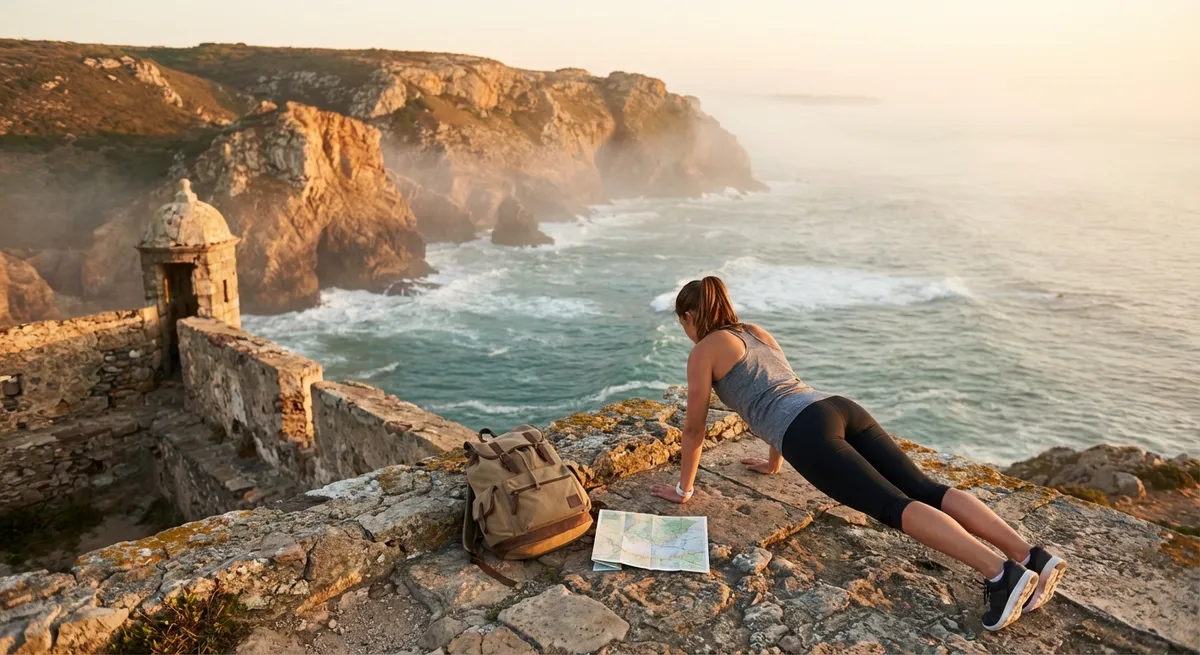
- A held plank overlooking a river, canyon, or city skyline
- A 60-second breath-focused stand (eyes closed, feet grounded) on a cliff edge trail or quiet plaza
Small, yes. But over time, these rituals become mental anchors: your body remembers how strong you felt on that Dubrovnik wall, that Icelandic black-sand beach, that rooftop in Mexico City. You’re not just collecting photos; you’re collecting embodied moments of strength.
Safety, Recovery, And Respect On The Road
Adventure doesn’t mean reckless. If you’re turning unfamiliar terrain into your workout space, a few habits keep you thriving trip after trip:
- Scout before you sprint. Walk routes first to spot loose stones, slick tiles, or sudden traffic.
- Check altitude and heat. High elevation and hot, humid climates can wipe you out faster than expected; start at an easy intensity and ramp slowly.
- Hydrate like it’s your job. Especially when flying often or training in the sun—dehydration sneaks up. Carry water on every session and drink before you feel thirsty.
- Respect local culture and spaces. Some plazas or religious sites may not be appropriate for intense workouts. If in doubt, move a block away or find a quieter corner of a park.
- Prioritize sleep and mobility. A few minutes of stretching or light yoga in the evening keeps your body ready for the next sunrise mission.
When you treat your body as your primary gear, you protect the one thing you can’t replace: your ability to keep saying “yes” to the next trail, beach, or rooftop.
Conclusion
The world isn’t asking you to wait for the “perfect” gym, routine, or schedule. It’s asking you to step outside, feel the ground tilt beneath your shoes, and let curiosity dictate your next rep. From cobbled alleys to alpine ridges, every place you visit can leave you stronger than when you arrived—if you dare to train where the map ends.
Pack light. Move often. Let landscapes sculpt you. And wherever you go next, don’t just pass through it. Sweat your way into the story.
Sources
- American Council on Exercise – Outdoor Exercise Benefits - Overview of physical and mental benefits of exercising outdoors
- Harvard Health Publishing – Green Exercise and Mental Health - Explains how time in nature can reduce stress and improve mood
- Centers for Disease Control and Prevention – Physical Activity Guidelines - Baseline recommendations for safe, effective activity levels while traveling and at home
- Mayo Clinic – Jet Lag and Sleep Tips - Guidance on managing jet lag, sleep, and body clock when traveling
- World Health Organization – Staying Safe in Hot Weather - Advice on hydration, heat exposure, and safe activity in hot climates