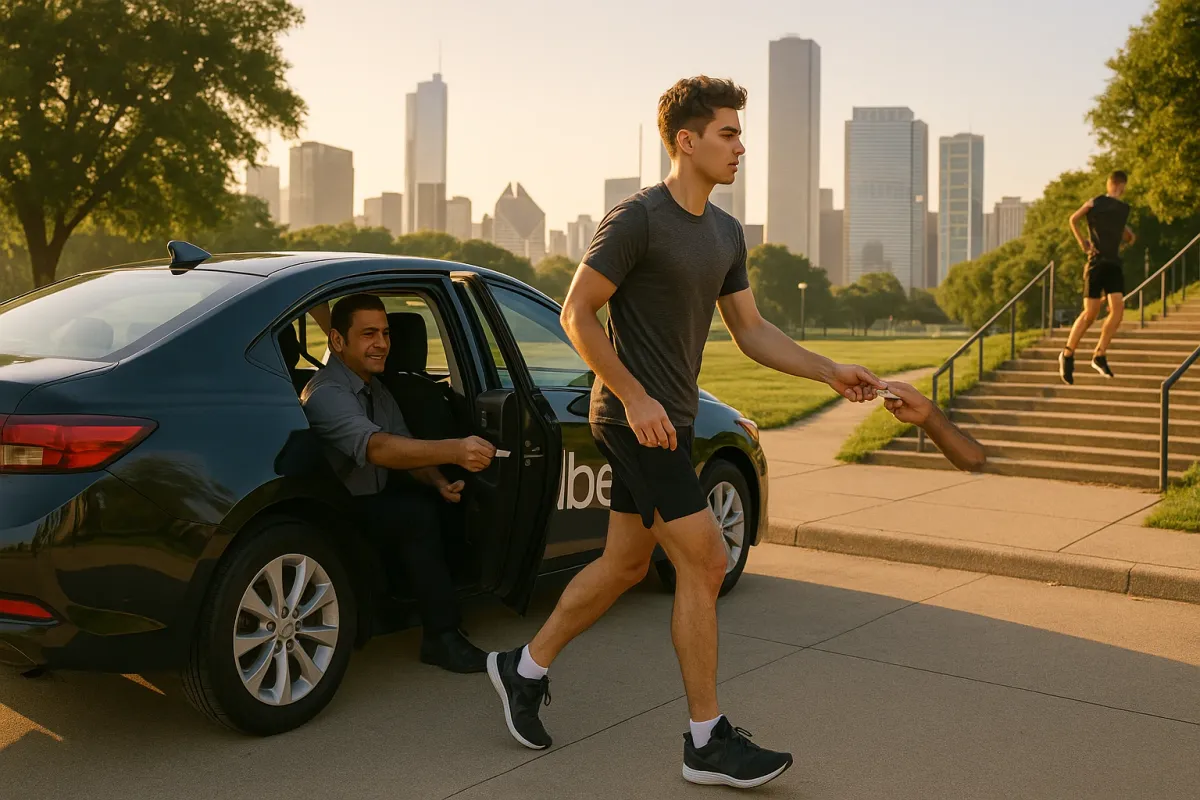
At Fit Voyaga, we’re asking a different question: what if those same rides became part of your adventure fitness strategy instead of dead time between epic moments?
The rideshare culture boom—whether it’s a late-night Uber in New York, a Bolt in Lisbon, or a Didi in Mexico City—has quietly rewired how travelers move through the world. You’re hopping between neighborhoods, viewpoints, and trailheads faster than ever. Let’s turn those point‑A‑to‑point‑B hops into an integrated, active, story-worthy way of traveling.
Below are five bold, ride-ready active travel tips to help you transform every Uber-heavy day into an adventure fitness experience—no gym, no routine, no excuses.
Build “Drop-Off Challenges” Into Every Ride
Rideshares are trending for what’s overheard inside, but the real magic for fitness voyagers happens the second the door closes behind you. Before you even request the ride, choose a drop-off point that forces movement—not the doorstep of your destination.
Ask to be dropped 1–3 km away from where you’re going: a ridge above your Airbnb in Cape Town, a block of stair-heavy alleyways in Lisbon’s Alfama, or across the river from your hostel in Budapest. That final stretch becomes your mandatory “arrival workout”—a brisk walk, stair sprint, or pack-carry up a hill. Suddenly, every outing starts or ends with a burst of movement that doesn’t feel like exercise; it feels like earning the view, the meal, the meetup. The more you play with distance and elevation, the more your daily logistics become a stealth endurance program.
Turn Transit Days Into Urban “Checkpoint Quests”
Those chaotic, multi-ride days—airport to hotel, hotel to dinner, dinner to nightlife—are prime time for most people to sink into exhaustion and screens. You’re different. Use each Uber stop as a fitness checkpoint in a citywide quest.
Map out three to four “checkpoints” around town: a riverside path in Seoul, a steep overlook in San Francisco, a beach access point in Barcelona, a park with pull-up bars in Berlin. Use rideshares only to hop between these zones, then walk, jog, or ride a rental bike inside them. At each checkpoint, complete a micro-workout—ten pushups with your pack on, a stair sprint, a short tempo run, a barefoot sand walk. By the end of the day you’ve stitched together a moving urban adventure, powered in between by Uber instead of framed around it. You’re still seeing the city—but now it feels like a course you were born to run.
Crowdsource Local Fitness Intel From Your Driver
The “Overheard Uber” trend proves one thing: people talk in rides. A lot. Instead of letting your ride become just another hilarious anecdote for the internet, treat each driver as a local adventure guide in disguise.
Skip the small talk and ask targeted fitness-quest questions:
- “Where do you see people running or working out outdoors around here?”
- “Is there a hill, staircase, or viewpoint locals go to for exercise?”
- “If you had to show someone the best sunrise or sunset spot, where would you drive them?”
In cities from Mexico City to Paris, drivers know where routes get flooded with cyclists, where locals climb before dawn, and where tourists almost never go on foot. Mark these spots on your map and build the next day’s workout around them. You’re no longer a visitor trail-running generic tourist paths—you’re tapping into the living, breathing fitness rhythms of the city you’re in.
Use the “Five-Minute Rule” to Reset Your Body Between Rides
Rideshares compress your geography but can wreck your mobility—tight hips, rounded shoulders, foggy focus. With the explosion of short social clips from the backseat (and all the slouching that comes with them), your body deserves a counter-ritual.
Adopt the Five-Minute Rule: for every ride you take, you owe your body five minutes of intentional movement immediately after stepping out. It could be a walking lunge circuit in a quiet side street in Athens, a set of hip openers on the promenade in Nice, or a simple mobility flow in a plaza in Buenos Aires. Think:
- 10–15 deep squats
- 10 slow lunges each leg
- 30–60 seconds of arm circles and shoulder rolls
- A short, brisk walk focusing on long strides and open posture
Do this after every ride for a full travel day, and you’ve transformed what most people treat as lazy, cramped downtime into a string of micro-reset rituals that keep you adventure‑ready and injury‑resistant.
Let Night Rides Power Next-Day Sunrise Missions
Late-night Uber rides—from rooftop bars in Tokyo or live music venues in Austin—often become fodder for viral stories, but for you they’re launch codes for tomorrow’s mission. On that final ride back, while the city glows outside the window, plan your sunrise adventure.
Ask your driver:
- “If you had to watch sunrise just once in this city, where would you go?”
Use that intel, plus your map, to identify a predawn drop-off point for the next morning. Set your alarm, throw on your gear, and take an early Uber to within 2–4 km of the view—then run, power-hike, or fast-walk the last stretch in the blue hour. By the time the city wakes up, you’ve already logged a workout, claimed a summit, and earned a story that’s infinitely better than “I slept in and scrolled Reels.” Your rideshare isn’t an endpoint; it’s a slingshot into the most magical training window of the day.
Conclusion
The world may be laughing at what’s overheard in Ubers, but you’re writing a different script—one where every ride is a portal to movement, every drop-off a fresh trailhead, every driver a potential co‑conspirator in your next challenge.
Adventure fitness doesn’t just live on mountaintops and desert crossings. It lives in how you move through ordinary moments—transit days, late-night returns, random city hops—and insist on making them extraordinary. Next time you slide into the backseat, don’t just open your phone. Open a map, a question, a tiny challenge.
Your journey isn’t on pause between destinations. With the right mindset, the adventure never stops.