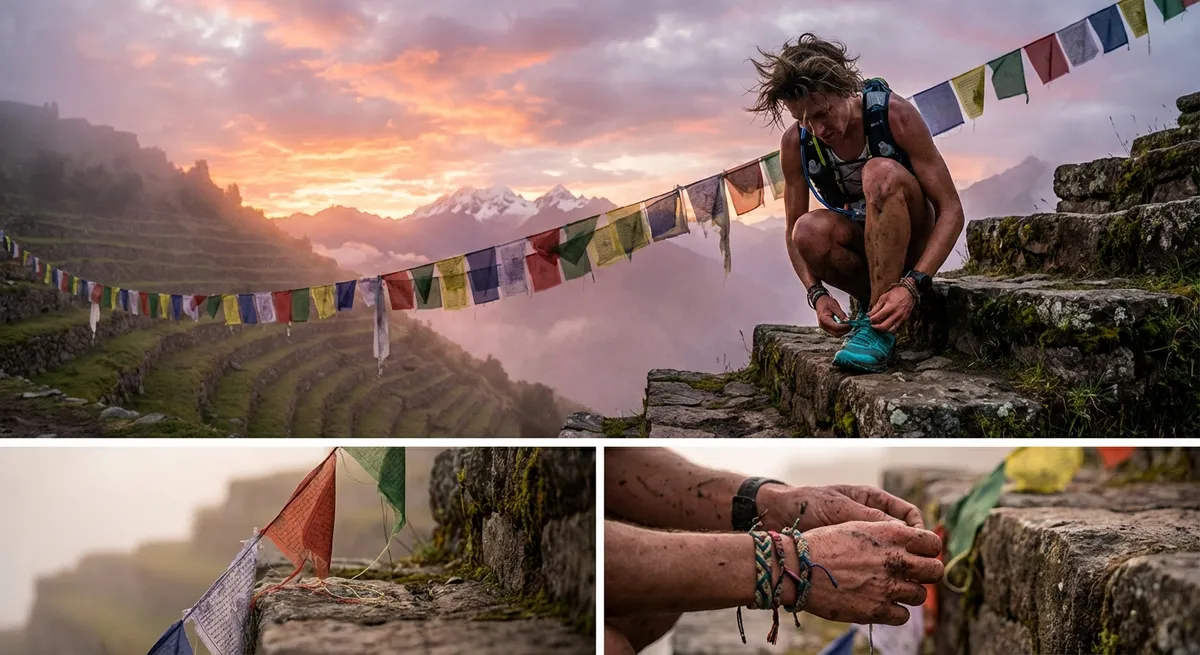
The World as Your Moving Gym
Your best workout may not happen under fluorescent lights; it might unfold on a ridgeline in Patagonia or on a dawn-lit stairway in Lisbon. When you treat Earth as your training ground, everything changes: stairs become hill sprints, beaches become resistance tracks, and city parks turn into agility courses.
Adventure fitness is the mindset of building your physical life around exploration. It’s saying yes to the steep trail instead of the viewpoint cafe, choosing the kayak over the tour boat, and planning a trip around what your body can do, not just what your eyes can see. In this world, you measure progress in more than reps—you measure it in how far you can hike in a day, how many meters you can climb, how long you can stay present in discomfort.
Every destination offers a unique “movement signature.” Think of:
- The volcanic stairs and black-sand beaches of Santorini as a lower-body power workshop
- The sandstone scrambles of Utah’s national parks as a functional strength playground
- The coastal paths of Portugal’s Algarve as a test of endurance and resilience
The art lies in spotting the opportunities in each landscape—and having the courage to chase them.
Tip 1: Plan Trips Around a Single “Flagship Challenge”
Before you book a single ticket, choose one bold physical objective that excites you and scares you just enough. This is your Flagship Challenge—the gravitational center of your entire trip.
Maybe it’s:
- A multi-day trek on the Laugavegur Trail in Iceland, where steam vents and glacial rivers become checkpoints for your stamina
- A sunrise summit of Mount Batur in Bali, timing your climb so you crest the volcano as the sky ignites
- Cycling from village to village in northern Vietnam, turning every mountain pass into a test of grit
Once your Flagship Challenge is set, you reverse-engineer your journey around it: where you stay, how you train before departure, what gear you pack, and how you recover. The challenge gives your trip a narrative arc—a beginning (training), a climax (the attempt), and a resolution (your reflection and recovery).
This approach transforms travel from a series of disconnected days into a purposeful expedition. You’re not just going somewhere—you’re going after something.
Tip 2: Train for the Terrain, Not Just the Trip
Generic “get fit for travel” workouts won’t unlock your best performance on a steep Andean trail or a choppy Mediterranean sea kayak route. Train for the specific demands of your destination.
Start by asking three questions about your chosen place:
How will I move most of the time? (Hiking? Paddling? Cycling? Climbing?)
What will the terrain demand? (Elevation, heat, sand, cobblestones, ice, humidity)
Where will fatigue hit first? (Legs, lungs, grip, core, mental focus)
Then, build a pre-trip training block that mimics those realities:
- Heading to the Dolomites for via ferrata adventures? Focus on pull-ups, loaded carries, step-ups, and grip work paired with long, moderate-intensity hikes.
- Planning a week of surf and trail running in Costa Rica? Blend tempo runs, hill repeats, mobility sessions, and shoulder stability work to handle the paddle-outs.
- Trekking in Peru’s Sacred Valley? Train with weighted pack walks, stair climbs, and moderate cardio to prep your cardiovascular system for altitude demands.
By the time you land, your body already “speaks the language” of the landscape. You’re not just coping with the environment; you’re ready to play with it.
Tip 3: Turn Transit Days Into Secret Conditioning Sessions
Airports, stations, and bus depots usually mean stiff backs, swollen ankles, and lost training days. For adventure athletes, they’re also a chance to sharpen discipline and sneak in low-key conditioning.
Without being “that person” doing burpees in the boarding line, you can still build meaningful movement into transit:
- Pace the terminal with intentional walking intervals—10 minutes brisk, 5 minutes easy—while waiting for boarding.
- Use quiet corners for calf raises, wall sits, hip flexor stretches, and shoulder mobility drills.
- On trains and long-haul flights, set a timer to stand, stretch, and walk the aisle every hour.
Imagine arriving in Chamonix or Queenstown with your joints already awake and your circulation dialed in, instead of spending your first day shaking off stiffness. Movement becomes your travel insurance: it protects your energy, protects your mindset, and protects the Flagship Challenge you came for.
Tip 4: Choose Lodging That Boosts, Not Blocks, Your Adventure
Where you sleep can either dilute your training or supercharge it. Ditch the mindset of “somewhere cheap and central” and start thinking “somewhere strategic for movement.”
Look for lodging that:
- Sits within walking distance of trailheads, parks, or coastal paths
- Has safe, scenic routes for early-morning runs or walks
- Offers access to a gym, pull-up bar, or at least sturdy stairs
- Provides easy storage for bikes, boards, or climbing gear
Consider staying in smaller mountain towns near big-name adventure hubs. For example, base near, but not in, Interlaken if you’re chasing Swiss alpine hikes—you’ll wake closer to quiet trails and finish closer to the night sky. In coastal regions like Spain’s Costa Brava, pick villages laced with cliff paths so a “simple walk to dinner” becomes a golden-hour hike above the sea.
Your accommodation isn’t just a place to crash. It’s your basecamp, your recovery zone, your launchpad. Choose it like an athlete planning an expedition, not a tourist hunting a deal.
Tip 5: Let Local Culture Expand Your Definition of “Workout”
Some of the most transformative “training sessions” happen when you temporarily forget you’re training at all. Seek out local movement traditions and let them challenge your body in new ways.
Consider:
- Joining a sunrise capoeira circle on a Brazilian beach, discovering strength, rhythm, and agility in one explosive art form
- Learning basic Muay Thai drills in a Bangkok gym, feeling how balance and core control change your sense of power
- Trying tango in Buenos Aires or salsa in Cali, Colombia, treating each dance session as cardio, coordination, and confidence practice
- Signing up for a beginner freediving or breathwork class in places like Dahab or the Canary Islands, exploring how your nervous system responds to new kinds of stress
These experiences light up muscles you rarely use and mental circuits you usually ignore. They also connect you, deeply and instantly, to the soul of a place. You’re not just looking at culture through a lens—you’re sweating inside it.
Destination Highlights to Ignite Your Next Adventure
Want to see what a fitness-first itinerary might look like in the wild? Use these destinations as launchpads for your own designs:
- Madeira, Portugal – A volcanic island sculpted for endurance athletes. Run the cliff-hugging levada trails, power-hike to Pico Ruivo above the clouds, and use steep coastal stairs as natural interval training.
- Banff & Jasper, Canada – Glacial lakes, dramatic passes, and trail systems for every level. Design your week around progressive hikes, from mellow valley walks to summit pushes that torch your legs and reward your soul.
- Queenstown, New Zealand – Known as the “adventure capital of the world” for a reason. Mix trail runs on the Ben Lomond Track with lake kayaking, mountain biking, and optional bungee jumps if you’re chasing adrenal spikes.
- Azores, Portugal – Atlantic islands with crater lakes, hot springs, and ocean cliffs. Alternate between trail runs, canyoning, whale-watching by kayak, and recovery soaks in geothermal pools.
- Patagonia (Chile & Argentina) – A cathedral of wind, stone, and ice. Build your experience around multi-day treks in Torres del Paine or Los Glaciares, practicing pack management, pacing, and mental grit under big skies.
Each of these places offers more than pretty views; they offer laboratories where you can test your limits, rewrite your story about what you’re capable of, and come home with a body that carries not just strength, but stories.
Conclusion
Adventure fitness is not a side quest tucked into “real life.” It’s a way of living where your training and your travels are the same journey: an ongoing experiment in courage, capacity, and curiosity. By anchoring your trips around a Flagship Challenge, training for the terrain, using transit as a tune-up, choosing strategic basecamps, and absorbing local movement traditions, you turn every journey into a chapter of your athletic evolution.
Your passport doesn’t just document where you’ve been—it can record who you’ve become. The trail, the ridge, the river, the stairway—somewhere out there, a landscape is waiting to show you a stronger version of yourself. Pack your courage, pick your challenge, and let the world be the weight room where your next story is written.
Sources
- Centers for Disease Control and Prevention – Physical Activity Guidelines – Overview of recommended activity levels and types of exercise for adults
- American College of Sports Medicine – ACSM’s Guidelines for Exercise Testing and Prescription – Evidence-based principles for training, conditioning, and preparing for physical challenges
- U.S. National Park Service – Hiking Basics – Practical advice on preparing for hikes, including safety, gear, and conditioning
- Adventure Travel Trade Association – Adventure Travel Trends Snapshot – Insights into global adventure travel patterns and traveler preferences
- Harvard T.H. Chan School of Public Health – Physical Activity and Health – Research-backed information on the health benefits of regular, varied physical activity