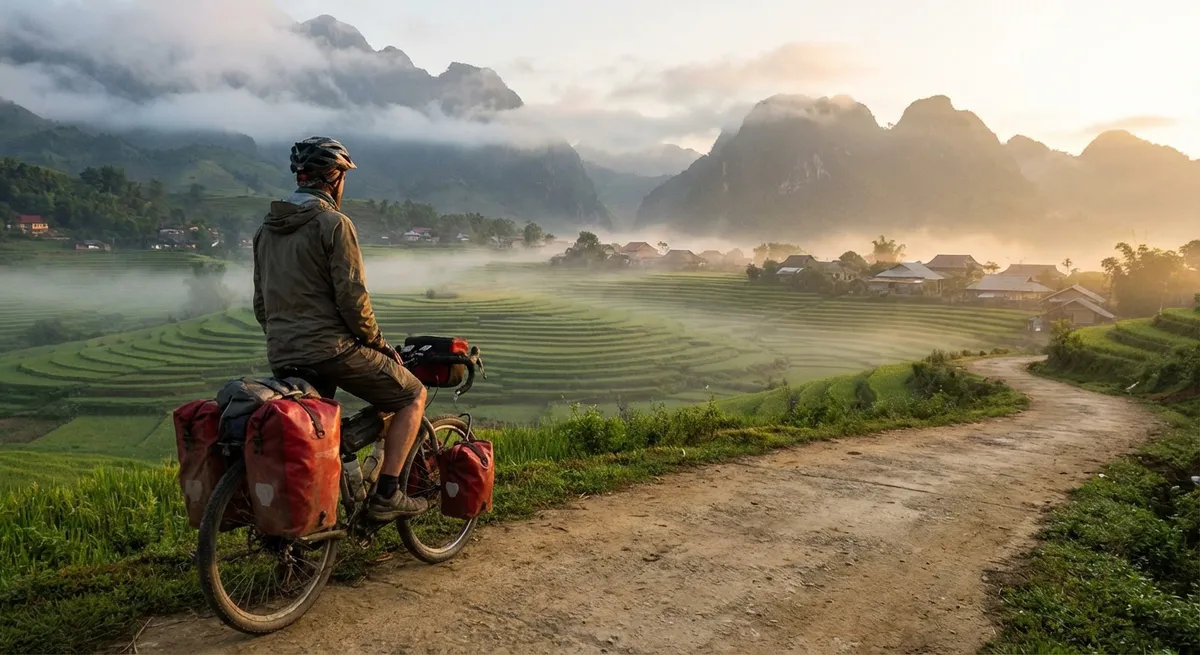
Why Active Travel Hits Different
Active travel isn’t about coming home exhausted—it’s about returning expanded.
When you build movement into your journey, you experience a destination at street level, trail level, and sea level. Your legs learn the rhythm of new cities. Your lungs memorize unfamiliar altitudes. Your muscles collect stories that photos can’t capture. Instead of squeezing in a quick hotel workout, your entire day becomes a rolling, immersive session of motion.
This style of travel shifts your focus from passive sightseeing to full-body participation. You’re not just passing through; you’re climbing the viewpoints, paddling the coastlines, cycling the backroads, and hiking the ridgelines. The reward? Deeper cultural encounters, sharper memories, better sleep, and a surprising confidence that follows you home.
Tip 1: Choose Destinations That Naturally Keep You Moving
If you want movement to feel effortless, start by choosing places where activity is woven into the landscape and culture.
Think of:
- Cape Town, South Africa – Hike or trail run up Lion’s Head at sunrise, tackle Table Mountain’s Platteklip Gorge, then paddle along the Atlantic shoreline with views of the Twelve Apostles.
- Queenstown, New Zealand – Widely known as an adventure capital, you’ll find mountain biking, alpine hiking, bungee jumping, canyoning, and kayaking all within easy reach.
- Lofoten Islands, Norway – Jagged peaks plunge into icy fjords, creating world-class terrain for hiking, trail running, sea kayaking, and (for the bold) cold-water surfing.
- Chiang Mai, Thailand – Jungle hikes, temple climbs, cycling through rural villages, and Muay Thai training sessions blend culture and conditioning in one place.
- Madeira, Portugal – A volcanic island of steep levadas (irrigation channels turned hiking paths), dramatic coastal trails, and lung-busting staircases leading to sea viewpoints.
Look for destinations with a dense mix of trails, bike paths, public stairs, waterfront access, and parks. Cities like Vancouver, Barcelona, and Melbourne are packed with waterfront promenades and urban greenways that invite you to walk, run, skate, or cycle instead of defaulting to a taxi.
When movement is the easiest way to get around, you’ll rack up adventure without even trying.
Tip 2: Build Your Itinerary Around “Anchor Activities”
Instead of sprinkling in a random hike at the end of your trip, design your journey around anchor activities—big, intentional movements that give shape and purpose to your days.
Examples of anchor activities that turn a trip into an active odyssey:
- Multi-day treks
- Torres del Paine’s W Trek (Chile)
- Tour du Mont Blanc (France/Italy/Switzerland)
- The Laugavegur Trail (Iceland)
- Point-to-point cycling routes
- EuroVelo segments like the Danube Cycle Path
- Portugal’s Atlantic Coast routes near Porto and Lisbon
- Japan’s Shimanami Kaido island-hopping bike route
- Paddle-focused explorations
- Sea kayaking the Dalmatian Coast (Croatia)
- Stand-up paddleboarding in the Greek Isles
- Canoe camping in the Boundary Waters (USA/Canada)
- Skill-based intensives
- A week of surf camp in Ericeira, Portugal
- Rock climbing courses in Kalymnos, Greece
- Trail running camps in Chamonix, France
Lock in one active anchor every day or two—a sunrise summit, a coastal ride, a long city walk—to create a powerful rhythm: move, explore, refuel, recover, repeat. Everything else—cafés, museums, markets—becomes delicious “recovery time” rather than the entire agenda.
Tip 3: Pack Like an Athlete, Not a Tourist
Your bag is your mobile locker room. Pack with intention so you can move hard without carrying heavy.
Gear that earns its space in an active traveler’s pack:
- Ultralight, moisture-wicking layers
Merino wool or technical synthetics resist odor, dry quickly, and can be worn multiple days—perfect for hikes in Costa Rica or runs along the Amalfi Coast.
- One pair of do-it-all shoes
Choose a lightweight, cushioned, grippy shoe that can handle city pavement, light trails, and airport sprints. Trail-runners often hit this sweet spot.
- Compact training tools
Mini resistance bands, a jump rope, and a lightweight suspension trainer or yoga strap give you a full-body setup that fits in a small pouch.
- Sun and weather armor
A packable rain shell, hat, sunglasses, and reef-safe sunscreen keep you ready to hike in Scotland, kayak in Baja, or jog along a sunny Bali beach without worry.
- Hydration and recovery essentials
A collapsible water bottle, electrolytes, and a lacrosse or massage ball for tired calves and glutes can transform how you feel on day three or four.
The goal is versatility and repeat use. If an item doesn’t help you move more comfortably, recover better, or explore further, it probably doesn’t belong in your pack.
Tip 4: Use Everyday Terrain as a Training Playground
You don’t need a gym when the world is built with stairs, rails, slopes, and open space.
Turn ordinary travel moments into micro-adventures:
- Train stations and city hills
Turn long layovers or uphill neighborhoods into interval sessions. Walk one block, power-hike the next, jog the third. In cities like Lisbon, San Francisco, or Valparaíso, the streets themselves are a workout.
- Public stairs and viewpoints
Climb to castle ramparts in Edinburgh, hilltop churches in Porto, or fortress walls in Dubrovnik—then repeat a section a few extra times for bonus cardio before enjoying the view.
- Beaches and waterfronts
Soft sand running in Rio, barefoot sunrise walks in Zanzibar, or bodyweight circuits on the boardwalk in Santa Monica turn shoreline strolls into full-body sessions.
- Parks and plazas
Use benches, ledges, and railings for step-ups, incline push-ups, Bulgarian split squats, and tricep dips. Early mornings in central parks—from Bogotá to Berlin—are perfect for low-key bodyweight training.
- Stair sprints to landmarks
From the steps to Montmartre’s Sacré-Cœur in Paris to temple climbs in Bali, you can turn the final ascent into a quick, breath-stealing challenge that you’ll remember every time you see a photo of that spot.
By treating each destination as a dynamic obstacle course, you move beyond “I need to find a gym” and into “the whole city is my training ground.”
Tip 5: Train for the Adventure Before You Go
The trip doesn’t start at the airport—it starts with how you prepare your body weeks beforehand. Training for active travel doesn’t have to be complicated, but it should be intentional.
Focus on three pillars:
Endurance for long days
- Add a weekly longer walk, run, hike, or ride that mimics your upcoming adventure. - If you’re trekking in Peru or Nepal, build up to multi-hour hikes with a backpack. - For bike-heavy trips, progress your weekly ride distance and include some hills.
Functional strength for uneven terrain
- Prioritize squats, lunges, step-ups, deadlifts, and core work to support climbs, descents, and carrying a pack. - Practice single-leg movements for ankle stability on roots, rocks, and cobbles.
Mobility and resilience
- Incorporate hip, hamstring, and ankle mobility work 3–4 times per week. - If you’re planning high-altitude hikes or long treks, talk with a healthcare professional about acclimatization, previous injuries, and recovery strategies.
You’re not training to set records; you’re training to say yes more often once you arrive—yes to the extra viewpoint, yes to the spur-of-the-moment trail, yes to the final push up the ridge.
Destination Highlights to Spark Your Next Active Escape
Need a spark? Consider these active-travel canvases where every day can be a full-body story:
- Patagonia (Chile & Argentina)
Glacier-fed lakes, wild winds, and serrated peaks define a region built for trekkers and trail runners. Think long days on the W Trek, sunrise hikes near El Chaltén, and rowing or kayaking on turquoise waters under condor-patrolled skies.
- Dolomites (Italy)
A jagged limestone dreamscape laced with via ferrata routes, high-altitude trails, and alpine huts. Spend your days climbing ladders bolted into cliffs, hiking ridgelines, then refueling with hearty mountain food and Italian coffee.
- Azores (Portugal)
Volcanic islands rising from the Atlantic, perfect for crater-lake hikes, coastal runs, canyoning through waterfalls, and whale-watching by kayak. The terrain demands movement, and the hot springs reward it.
- British Columbia (Canada)
From coastal rainforest trails near Vancouver to alpine hikes and mountain biking in Whistler, you can paddle in the morning, hike in the afternoon, and still have time for a sunset run along the seawall.
- Japan’s Rural Routes
Walk ancient pilgrimage routes like the Kumano Kodo or Nakasendō Trail, where every day blends forest paths, mountain passes, hot springs, and small inns. It’s movement laced with deep cultural immersion.
Use these as inspiration, then sculpt your own path. The world is wide and waiting for your version of “active.”
Conclusion
Active travel is a declaration: you are not a spectator in your own life. You’re the one charging the hills, tracing the coastline, breathing hard at altitude, and earning your views step by step. When you choose destinations that demand movement, pack like an athlete, treat the environment as your playground, and train before you go, every journey becomes more than a trip—it becomes a personal evolution.
The map is no longer just places to visit, but landscapes to move through and memories to carve into your muscles. Lace up, pack light, and let your next adventure be the one where you don’t just go somewhere—you grow there.
Sources
- Centers for Disease Control and Prevention – Physical Activity and Health - Overview of health benefits associated with regular physical activity, relevant to active travel
- World Health Organization – Physical Activity Fact Sheet - Global guidelines and recommendations on physical activity for adults
- Harvard T.H. Chan School of Public Health – Benefits of Physical Activity - Evidence-based summary of how movement improves long-term health and wellbeing
- U.S. National Park Service – Hiking Tips - Practical safety and preparation guidance for hiking and trekking adventures
- Adventure Travel Trade Association – Adventure Travel Trends Snapshot - Industry research on adventure and active travel trends worldwide