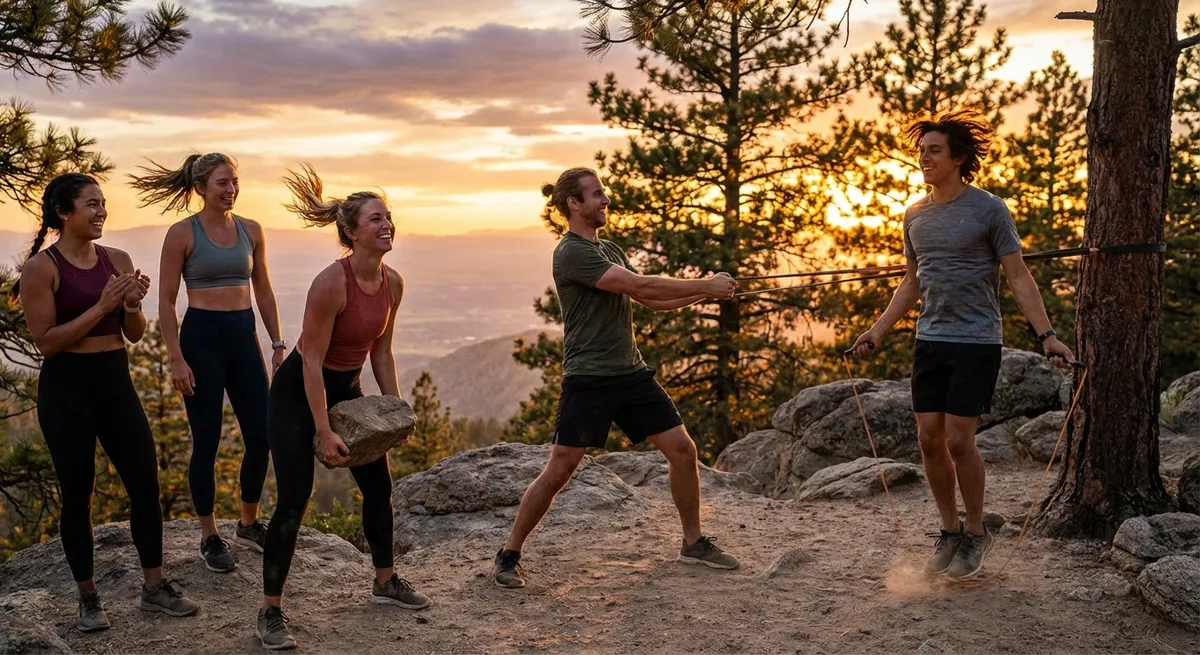
Reframing the World as Your Training Ground
Outdoor workouts on the road aren’t just a way to “keep up your routine”; they’re a chance to rewrite it.
When you step out of a hotel, hostel, or tent, look around with an athlete’s eyes. That steep alley becomes your hill repeat. The coastal boardwalk becomes your tempo run track. A park bench becomes your strength station. Training stops being something you squeeze in—it becomes the way you explore.
You’ll engage more senses than any indoor session: uneven terrain wakes up stabilizing muscles, changing weather builds resilience, and navigating new landscapes sharpens your focus. Studies on green exercise suggest outdoor movement can improve mood and perceived effort, making hard work feel more like play. Treat every new city, trail, or coastline as a custom-built obstacle course that only exists for you in this moment of your travels.
Destination Highlights: Natural Gyms Around the Globe
To light up your imagination, picture these destinations through a “move first, sightsee second” lens:
- Barcelona, Spain – Urban Strength & Sea Air
Jog the beachfront path from Barceloneta, stopping for push-ups, lunges, and triceps dips at benches along the way. Finish with stair sprints up to the Parc de Montjuïc overlooks, then walk it off while soaking in city-and-sea panoramas.
- Vancouver, Canada – Forest Cardio & Coastal Conditioning
Run or cycle the Seawall around Stanley Park, mixing in bodyweight strength at viewpoints. Add a trail session in the lush forests of Lynn Canyon, where roots, stairs, and bridges test balance and power.
- Cape Town, South Africa – Summit Workouts With Ocean Views
Use Lion’s Head or Table Mountain as your vertical training grounds. Hike hard to the summit at sunrise, then perform a short strength flow (squats, planks, glute bridges) at the top before descending with jelly legs and a full heart.
- Kyoto, Japan – Temple Stairs & Quiet Miles
Turn the long stairways up to temples and shrines into interval work: power up the steps, walk back down, repeat. Then enjoy a meditative jog along the Kamogawa River, letting the rhythm of your breath match the water’s flow.
- Patagonia, Chile/Argentina – Wind, Elevation, and Endurance
Trekking circuits around Torres del Paine or El Chaltén give you loaded carries, hill climbs, and unpredictable weather in one package. Every step under a backpack is functional strength in disguise.
Anywhere you go, you can find a version of these: a hill, a waterfront, a staircase, a loop around greenery. Your mission is to seek them out and turn them into rituals.
5 Active Travel Tips for Fitness-Fueled Adventurers
1. Scout Your “Adventure Zones” Before You Arrive
Before you land, spend 10–15 minutes mapping potential workout spots:
- Search “public parks,” “running trail,” “waterfront path,” and “outdoor fitness equipment” near your stay.
- Use satellite and street-view maps to check for stairs, hills, long flat stretches, and open plazas.
- Screenshot one short loop for a run, one hill/stair option, and one park or open space for circuits.
When you arrive, you won’t debate what to do—you’ll already have a mini adventure plan in your pocket.
2. Build a 20-Min “Anywhere Circuit” You Can Drop Into Any Landscape
Create one go-to bodyweight circuit that needs no gear and fits into a tiny square of space—then adapt it to your surroundings.
Example structure (repeat 3–4 rounds):
- 40 seconds: Squats or step-ups (use a curb, rock, or bench)
- 40 seconds: Push-ups (bench for incline, ground for standard)
- 40 seconds: Walking or jumping lunges
- 40 seconds: Plank variations (side plank, shoulder taps)
- 40 seconds: Fast stairs/hill power walk or high-knee run in place
- 60 seconds: Walk and breathe
On a beach? Squats and lunges in soft sand. In a city square? Use benches and low walls. In a forest? Log step-ups, tree-assisted rows, and hill sprints. The format stays; the scenery changes.
3. Treat Sightseeing as Endurance Training, Not Just Wandering
Instead of passive tours, design your days like endurance blocks:
- Walk the city instead of always using transit. Aim for 15,000–20,000 steps exploring neighborhoods on foot.
- Create “viewpoint intervals.” Mark 2–3 viewpoints or landmarks in different parts of town; brisk-walk or lightly jog between them.
- Use time, not distance. Plan 60–90 minutes of “active exploration” where the goal is continuous movement, not specific mileage.
This approach keeps your aerobic base strong and lets you taste more side streets, local snacks, and unexpected views.
4. Pack a Micro Gym That Weighs Under 1 kg
With a few lightweight tools, every destination becomes a serious training ground:
- Mini resistance band: Glute activation before hikes; quick leg and hip sessions in small spaces.
- Light long resistance band: Rows using a tree or railing; assisted pull work; added resistance for squats.
- Jump rope: High-intensity cardio when you’re short on time or safe running routes.
- Collapsible water bottle: Works as hydration AND a makeshift light weight when filled.
Use these for short “bookend” sessions: 10–15 minutes in the morning to wake up muscles, and another 10 minutes in the evening to stretch and flush out travel stiffness.
5. Sync Your Training With the Local Landscape and Culture
Let the place itself decide the flavor of your workout:
- Coastal town? Emphasize beach runs, stair climbs from shore to town, and sunrise mobility flows on the sand.
- Mountain village? Turn hikes into strength endurance by carrying your own pack, incorporating deliberate step-ups, and using rocks or logs for strength moves.
- Historic cities with narrow streets and hills? Try fartlek-style runs: alternate easy jogs through flat sections with strong power walks up every hill or staircase you encounter.
- Lakes and rivers? Add swimming, paddleboarding, or kayaking as natural cross-training.
Then reward yourself like a local: a post-workout espresso in Italy, a bowl of pho in Vietnam, or a bakery stop in France. This is performance fueled by culture, not in spite of it.
Staying Safe, Smart, and Wildly Curious Outdoors
Outdoor workouts in unfamiliar places demand both courage and common sense. Check local guidance about safe running areas, respect cultural norms around clothing and public exercise, and be extra visible if you’re out at dawn or dusk. Let someone know where you’re going, carry identification, and keep your phone charged with an offline map downloaded.
Hydration, sun protection, and gradual acclimatization to heat, cold, or altitude matter more when you’re exploring hard. Listen to your body: swap intensity for easy movement if jet lag hits, or shorten a planned long run if the climate feels more brutal than expected. You’re not here to prove anything to strangers—you’re here to build a body that can carry you farther, longer, and happier.
Conclusion
Your fittest self doesn’t live in a single gym, routine, or zip code. It’s scattered across the world: in the switchbacks of a mountain trail, the cobblestones of a medieval alley, the boardwalk of a sleepy surf town, and the sunbaked steps leading up to a temple.
When you choose outdoor workouts while you travel, you do more than maintain your fitness—you weave it into your story. Every hill sprint becomes a memory, every sunrise stretch a small vow to keep exploring. Pack light, move boldly, and let the map decide tomorrow’s training plan. The next chapter of your fitness journey might be waiting at the top of a staircase you haven’t climbed yet.
Sources
- American Council on Exercise – The Top 10 Benefits of Outdoor Exercise - Overview of physical and mental benefits of exercising outside
- Harvard Health Publishing – Exercising Outdoors Has Many Mental Health Benefits - Explores how outdoor movement can improve mood and reduce stress
- U.S. National Park Service – Hiking Safety - Practical guidance on staying safe and prepared for outdoor and trail activities
- Gov.uk – Heatwave: How to Cope in Hot Weather - Useful for understanding hydration and heat safety during outdoor workouts
- Stanley Park Seawall – City of Vancouver - Example of an urban waterfront route ideal for outdoor running and cycling workouts