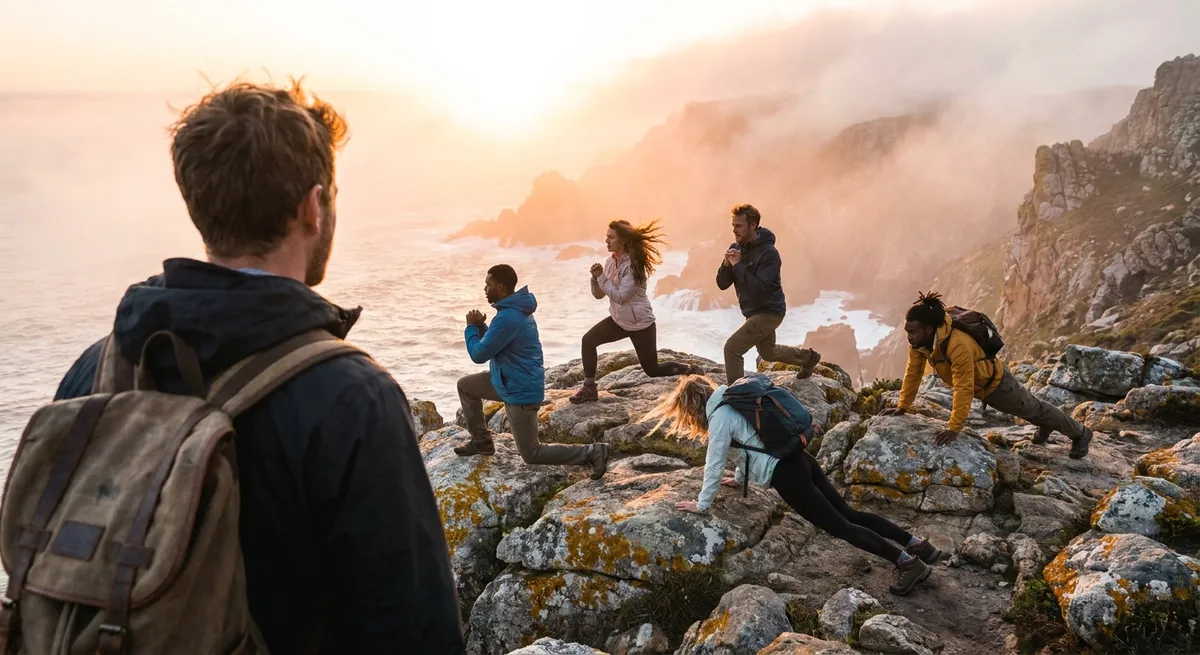
This guide will show you how to build powerful, memorable workouts into your adventures—plus five active travel tips to help you move more boldly in every destination.
Claim the Landscape: Why Training Outside Hits Different
When you swap walls for skyline, fitness stops being a chore and becomes a quest.
Uneven ground secretly upgrades your balance and joint stability with every step, as your muscles fire in micro-adjustments that a flat gym floor can’t replicate. Wind resistance on a coastal run becomes nature’s version of a resistance band, making your body work just a little harder for every stride. Sunlight boosts vitamin D and can help regulate your circadian rhythm, which means sleeping better after long travel days—and waking ready to chase another horizon.
Psychologically, outdoor movement is a powerful reset button. Studies link green and blue spaces—think forests, lakes, and oceans—to lower stress and better mood, and those benefits can hit in as little as a 20–30 minute walk. When that “walk” is a sunrise hike overlooking Rio’s Guanabara Bay or a twilight jog along Copenhagen’s harbor, the mental payoff multiplies.
Most importantly, outdoor workouts stitch you into the stories of the places you visit. You don’t just see a city; you climb its stairs, feel its cobblestones under your feet, breathe its early-morning markets before the crowds arrive. Fitness stops being separate from travel and becomes the way you experience it.
Destination Moves: How to Train With the World, Not Against It
Every location has a signature “move” hiding in plain sight. Once you learn to spot it, you’ll never look at a skyline—or a map—the same way again.
On rugged coastlines like Portugal’s Algarve or South Africa’s Garden Route, the mix of cliffs, sand, and surf begs for intervals: hill sprints up sandy paths, walking lunges along the packed shoreline, then a cool-down wade in the shallows. In mountain towns like Chamonix, Queenstown, or Banff, elevation turns even a steady hike into a lung-expanding workout; add micro-challenges—10 push-ups at every viewpoint, a 30-second wall sit after each bridge—and you lace strength work into your exploration.
Historic cities are stealth training zones. In Lisbon, Istanbul, or Edinburgh, climb every staircase you see: castle steps, alleyway stairs, metro exits. Take them two at a time when it’s safe, or power-march with strong arm swings. Parks in cities like Vancouver, Singapore, or Barcelona give you benches for triceps dips, step-ups, and incline push-ups, plus open lawns for mobility flows or short, sharp bodyweight circuits.
The goal isn’t to force your usual gym routine onto new terrain; it’s to let the terrain rewrite your routine. Let the place dictate the movement: dunes mean power; river paths suggest distance; markets invite loaded carries with your fresh groceries; forest trails whisper “slow down, breathe deeper, go longer.”
5 Active Travel Tips for the Relentlessly Curious and Always Moving
1. Plan Your Days Around a “Movement Anchor”
Instead of asking, “Can I squeeze in a workout?”, decide your day around one key movement moment: a hike, a ride, a swim, a long city loop on foot.
In the Dolomites, that anchor might be a half-day via ferrata climb. In Kyoto, it might be a pre-dawn walk through the torii gates of Fushimi Inari before the tourist rush. In Patagonia, maybe it’s a daily 5–8 km trek from your base hostel. Once the anchor is set, everything else—cafés, museums, sunset views—becomes a bonus orbiting your main adventure.
Movement anchors help you avoid the “I’ll do it later” spiral that travel often triggers. You wake knowing there’s a challenge waiting, and the rest of the day feels earned.
Try this: Pick one anchor day per destination that pushes you a little further—a longer hike in Madeira, a guided kayaking day in Norway’s fjords, or a bike circuit around Bali’s rice terraces.
2. Pack a “Micro Gym” That Fits in Your Daypack
You don’t need a trunk full of gear to stay strong across time zones. A tiny “micro gym” turns any patch of ground into a training zone.
Slip into your bag:
- A light to medium resistance band for rows, pull-aparts, and hip work
- A mini-loop band for glute activation before hikes or runs
- A compact jump rope for quick, all-weather cardio when trails are muddy or streets feel hectic
On a balcony in Santorini, loop a band around a railing and hit rows and face pulls between sips of Greek coffee. In a Bangkok hotel room, pair mini-band squats with slow, controlled push-ups. On a long layover, find a quiet corner and run through 5–10 minutes of banded mobility to wake your travel-stiff joints.
Your micro gym keeps you from feeling “off” just because you’re away from your usual equipment—and it makes it easier to train smart in places where gyms are rare or pricey.
3. Use Local Terrain to Cross-Train Like an Athlete
Travel is your chance to borrow the “home sport” of a destination and let it reshape how you move.
In Costa Rica, trade treadmill time for surf lessons—the constant pop-ups, paddling, and balance work torch your upper body and core while teaching you to read waves and currents. In Finland or Canada in winter, cross-country skiing or snowshoeing becomes a full-body endurance builder that also exposes you to frozen lakes and silent forests tourists rarely see.
On Croatia’s islands, rent a kayak or stand-up paddleboard and turn sheltered coves into intervals: 1–2 minutes of hard paddling, then a float to admire stone villages and hidden beaches. In Amsterdam or Copenhagen, cycling is not just transport; it’s a daily leg and cardio session that glides you through canals and side streets you’d never find by car.
These borrowed sports unlock muscles you forget you have—and give you stories infinitely richer than “I hit the hotel gym.”
4. Build Active Recovery Into Your Itinerary, Not After It
Rest days don’t have to mean lying motionless in your hostel bunk. Think of active recovery as slow-motion exploration.
In Iceland, a soak in geothermal pools after hiking glaciers doubles as both a cultural ritual and muscle relief. In Japan, an onsen visit post-trail is almost a sacred cooldown. In beach destinations like Hawaii, the Canary Islands, or Thailand, easy snorkeling sessions can loosen tight hips and shoulders while you drift over coral gardens.
On “tired legs” days in cities like Rome, Prague, or Buenos Aires, ditch public transport for gentle wandering: 8,000–10,000 unhurried steps through side streets, riverbanks, and neighborhoods beyond the tourist core. Add in 5–10 minutes of calf, hamstring, and hip flexor stretches back at your stay, and your body resets for the next big push.
When recovery is woven into your travel plans—thermal baths, slow cycling, waterfront walks—you arrive at each new challenge refreshed, not wrecked.
5. Chase Sunrises, Not Lines: Move When the World Is Quiet
Some of the best travel workouts happen while everyone else is still asleep.
Pre-dawn sessions in cities like Paris, New York, or Mexico City mean you get iconic routes—the Seine, Central Park, Chapultepec—almost to yourself. The air is cooler, the streets belong more to locals, and your camera roll fills with golden light instead of crowds.
On islands like Santorini, the Azores, or the Philippines, hiking before sunrise lets you reach viewpoints just as the sky ignites—and descend before midday heat. In desert regions like Utah’s national parks or Morocco’s dunes, early movement is safer and far more magical: your footsteps the only marks on fresh sand, shadows stretching long and dramatic.
Sunrise training also stabilizes jet-lagged sleep. Move with the local morning light, and your body clock adjusts faster. You finish your workout just as the cafés open, and by the time everyone else lines up at attractions, you’ve already logged miles, memories, and a quiet victory.
Conclusion
The world doesn’t need to pause so you can stay fit—and your fitness doesn’t need to pause so you can see the world. When you treat every new landscape as a training partner, your workouts turn into stories: the stormy cliff run that left you soaked and laughing, the ancient stairway that burned your legs and rewarded you with a city-wide view, the silent forest trail that cleared your head after a long travel day.
Outdoor training on the road isn’t about perfection or rigid plans. It’s about choosing movement over inertia, curiosity over convenience, and adventure over the familiar four walls of a gym. Pack your curiosity, your micro gym, and a willingness to say “yes” to the terrain in front of you—and let the planet shape a stronger, braver version of you, one destination at a time.
Sources
- Harvard Health Publishing – Exercising Outdoors Has Mental Health Benefits - Explores how time in nature reduces stress and supports mental well-being
- Centers for Disease Control and Prevention – Physical Activity Guidelines - Outlines recommended activity levels and health benefits of regular movement
- American Council on Exercise – Benefits of Outdoor Exercise - Reviews physiological and psychological advantages of training outside
- National Park Service – Hiking Tips - Provides safety and preparation tips for trail hiking in varied terrains
- Mayo Clinic – Travel and Exercise Strategies - Offers guidance on staying active and healthy while traveling